
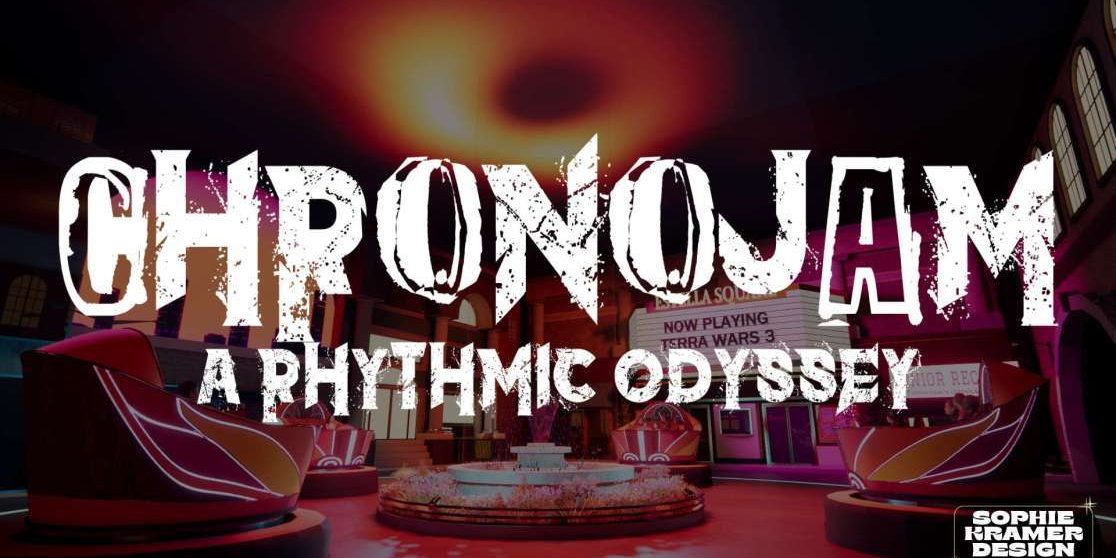
ChronoJam: A Rhythmic Odyssey
Created and Designed by Sophie Kramer
Individual Submission
Ringling College of Art and Design, BFA Entertainment Design 2025
“ChronoJam: A Rhythmic Odyssey ” is a thrilling, trackless dark ride that blasts you through time, blending animated media with physical sets, allowing guests to travel through the music of the past, present, & tomorrow!”
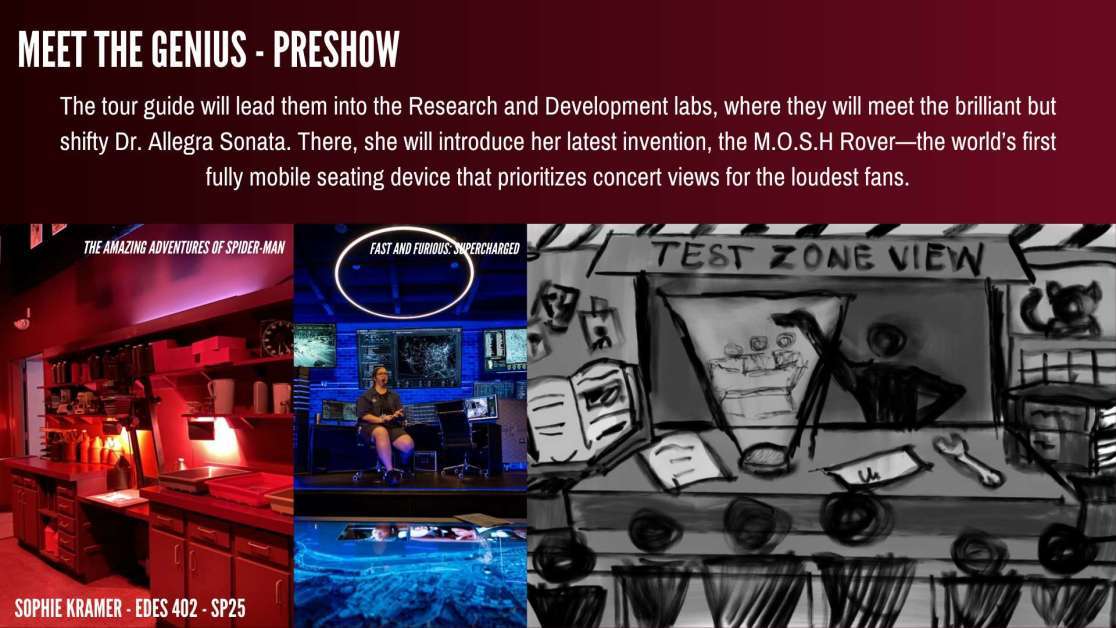
What starts as a concert product demo turns wild when Reese, a wannabe rocker-turned-janitor, accidentally triggers the M.O.S.H. Rover’s hidden time-travel function, sending unsuspecting guests on a turbulent trip into the heart of history’s greatest musical moments. Now, it is up to guests to jam, scream, and shake up the past to power more sound portals and stop Dr. Allegra Sonata, the desperate genius behind the rover, from stealing legendary musical artifacts and rewriting history forever.
Developed in conceptual schematic form for my senior capstone thesis project, ChronoJam is an original IP-based attraction inspired by my love for time-travel films, art and music history, and the dark rides of yesterday and today. While working on this project over the course of a year, I was able to apply a myriad of software and design skills learned in my time at Ringling while exploring many DOWs that I feel passionate about and wish to continue in my professional career. I am so thankful to have completed such a rewarding project and to be able to share it with the world! If you’d like to learn more about the project or my other works, find me here:
Website: https://www.sophiekramerdesign.com/
LinkedIn: https://www.linkedin.com/in/sophie-kramer-design/
Story and Concept Development
When first tasked with ideating this attraction, I began by breaking my core concept down into an elevator pitch that secured my approval to proceed ahead in the development process: ” an unexpected and chaotic time travel joyride through the history of musical development.” From here, I dove headfirst into the research aspect of this story and started asking key questions: what movements were crucial to the evolution of music? When did these movements occur? Which of these movements could lend themselves to a bit of danger and excitement for the sake of guest entertainment?!”
Throughout the story development process and after consulting with both Ringling faculty and one of my amazing thesis mentors, Steven Walker of Wacky World Studios, the framing structure of the time travel journey shifted from a straight line path through the development of music as a whole to traveling through the peaks of different musical genres. Not only did this shift allow for a chance to demonstrate more subcultures and to recreate more geographic areas, it also allowed for broader guest recognition and appeal–a vast and essential factor in attraction development.
In tandem with developing the story for this attraction, I also asked myself how I would propose an innovation to the beloved craft of dark ride attraction development. The answer hit me in the middle of the summer before senior year began: what if there was a way to take the formulaic algorithm layout of attractions like Star Tours and combine it with the split track paths seen in modern trackless dark ride attractions like Mickey and Minnie’s Runaway Railway and Star Wars: Rise of the Resistance. Could there be a way to have different combinations of physical show scenes amongst different ride vehicles running in tandem, creating more unique experiences to be explored? For experimentation, the faculty and I agreed to explore the ride that could be made if the answer to this big question was yes.
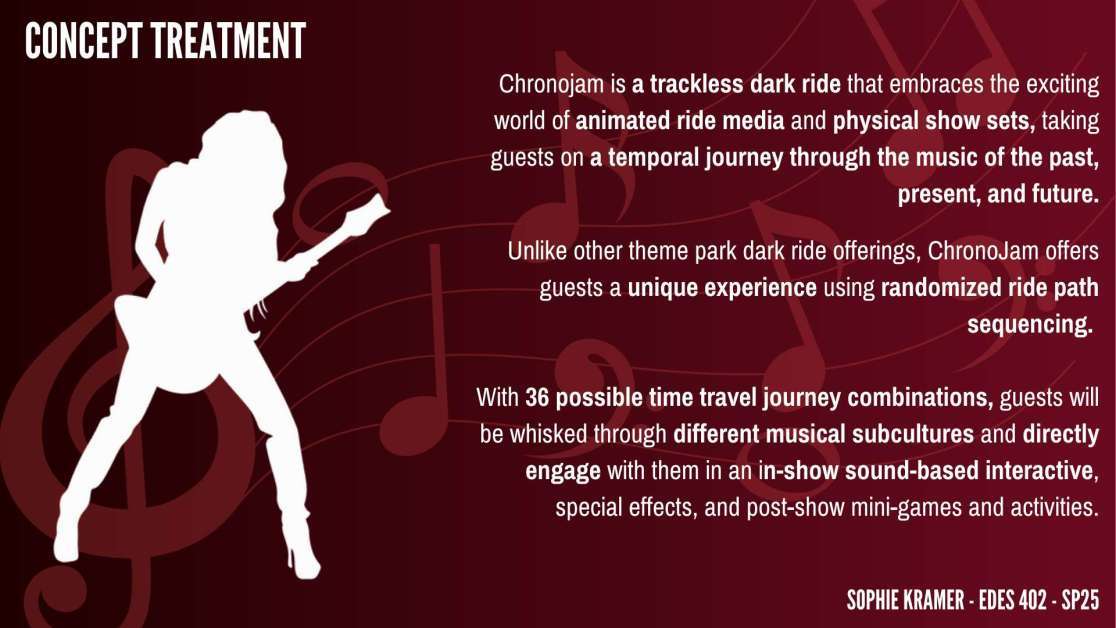

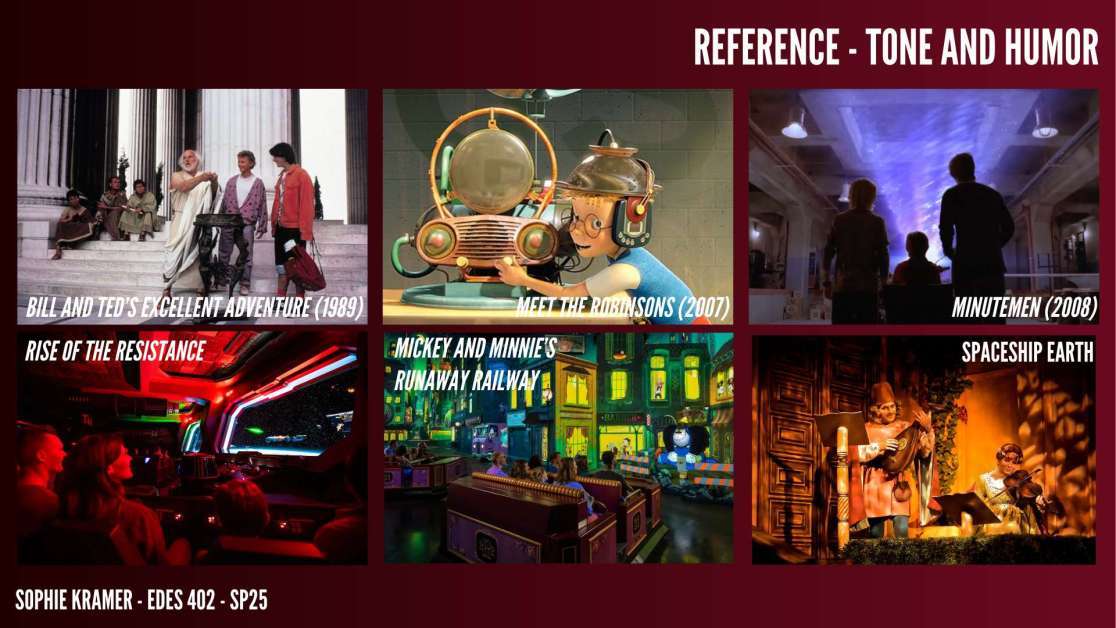
The next step in this development process was nailing down these key experience beats, collecting tonal and architectural reference, and generating storyboards and moodboards for these many different stops on a guest’s journey through this attraction. During this time, the many genres I explored slowly narrowed down to the nine options presented in the presentation deck. This selection, covering a wide range from polka to electronic/EDM, felt natural and diverse enough to have unique feelings and scenes without feeling redundant. Most importantly, I felt there was a through line of influence from one genre to the next, allowing them to blend well during scene transitions and into the genre medley of the original song at the end of the time travel sequences before the guests return to the present CGDD.






I also took the initiative to create a script template to show the main framing structure and show scenes for the attraction that all guests would experience, to be expanded upon to be made for each of the three ride vehicles in a single ride cycle. In theoretical further development, there would be approximately 108 script variants for the ride vehicles to cover the 36 possible combinations that could occur. Below are some page samples from said frame document, which can be fully viewed here.


Under the tutelage of my other incredible thesis mentor, Kevin Primm, a Show Set Designer at Universal Creative, I created a show timing sheet for the ride cycle itself and calculated my hourly and daily rider capacity. Although it was on the slightly lower side, in further development, this could be remedied in many ways.

Technology Research and Applications
Another element of attraction development that I wanted to explore was ride systems technology and special effects. In between story and concept development, I researched different ride systems that would meet my desired needs.
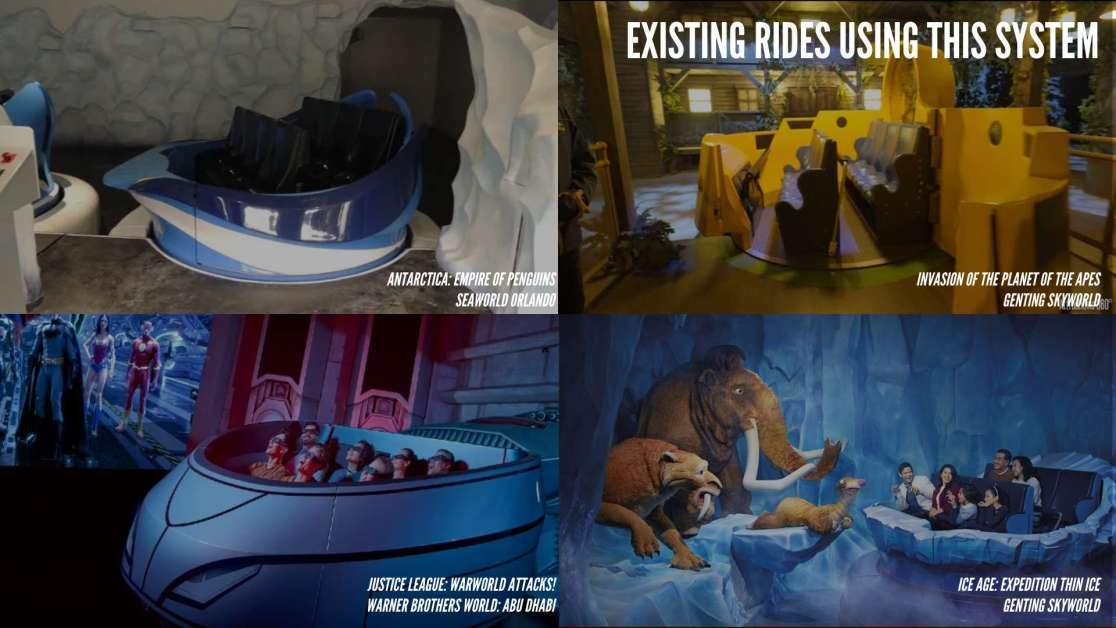
I found my answer in the Oceaneering REVOLUTION™ Tru-Trackless™ Motion-Base Ride System. This trackless dark ride system has been featured in real-world attractions across the globe for over a decade. This fantastic ride system has an abundance of exciting features including a programmable 3 degrees of freedom 360° motion base, surround sound speakers, a monitorable locking lap-bar system, & integrated theming and on-board gaming elements. I even spoke to some representatives from Oceaneering online about my concept and learned so much more about the specs of this vehicle and its potential, making it clear that this would be the right fit for ChronoJam.
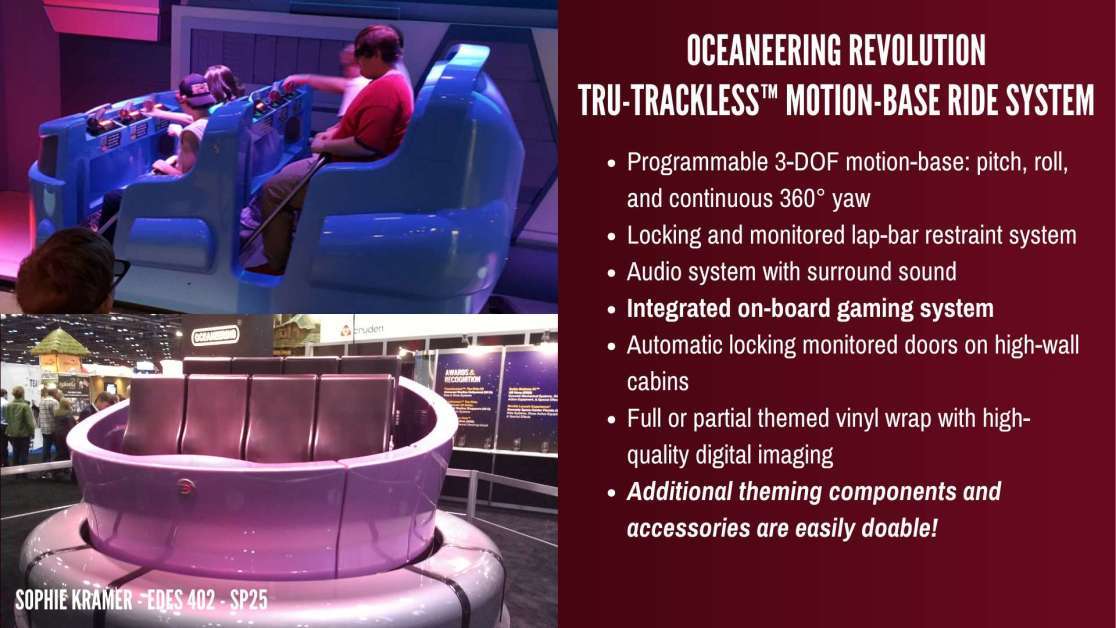
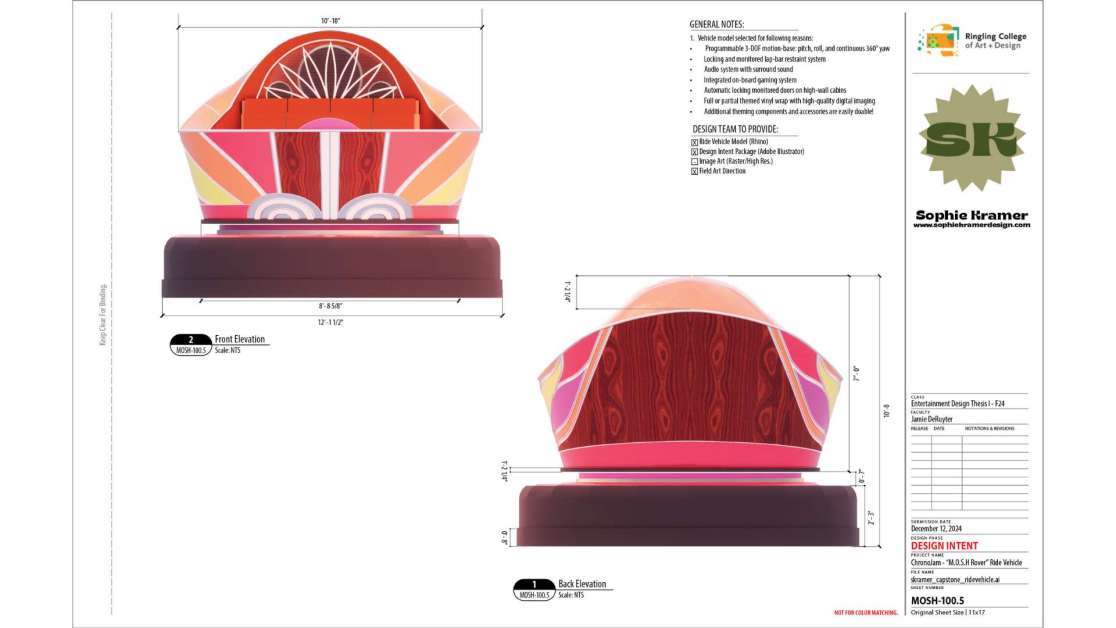
When developing the exterior cabin theming, I wanted to ensure that the vehicle’s design included hints of musical influences. Quickly, I looked at music technology, ranging from instruments to speakers. However, nothing called to me like the amazing shape language and materials of 1960s jukeboxes, which slowly worked their way into my sketches. Narratively, the M.O.S.H. Rover was created by Dr. Allegra Sonata and her tech start-up team, the Concert Globalization Development Directive, as the world’s first fully mobile seating device. This influence, mixed with a bright and fun 1960s color palette, really brought the rover to life!


To truly perfect this design, I modeled the vehicle in Rhino 3D. Bringing this concept from sketch to a fully dimensioned model and design intent package was very rewarding. Another special thank you must be extended to my professor, Seongwoo Nam, and my mentor, Kevin Primm, for helping me find the information that allowed me to make this model as lifelike as possible and for tweaking my design with me over the course of several months. Here is a full animated turn-around of the rover and excerpts from the design intent document, found in full here.


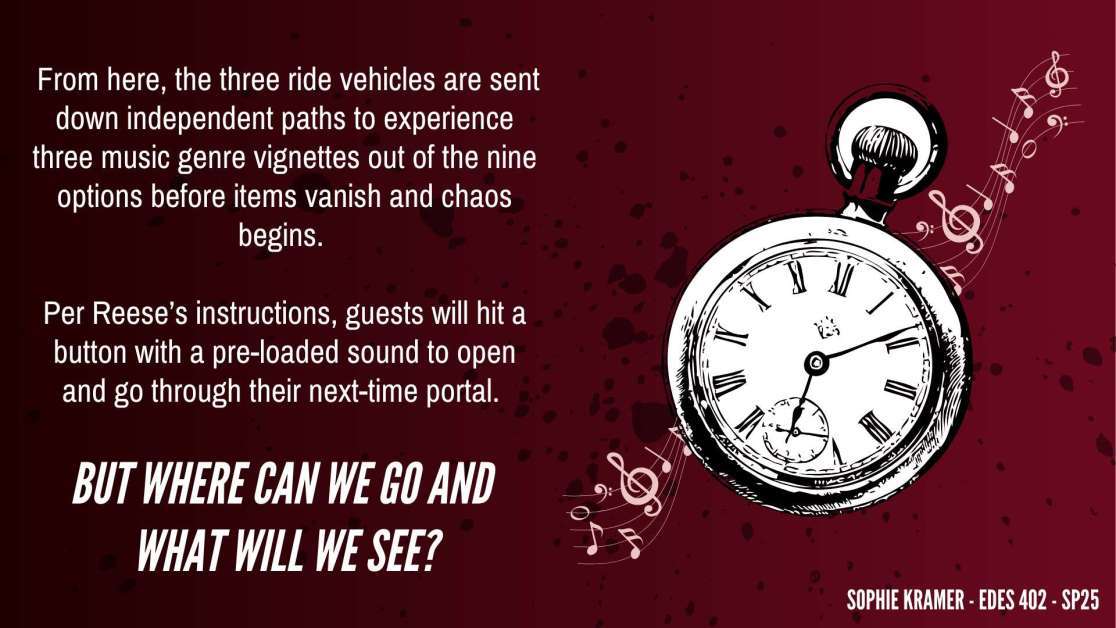
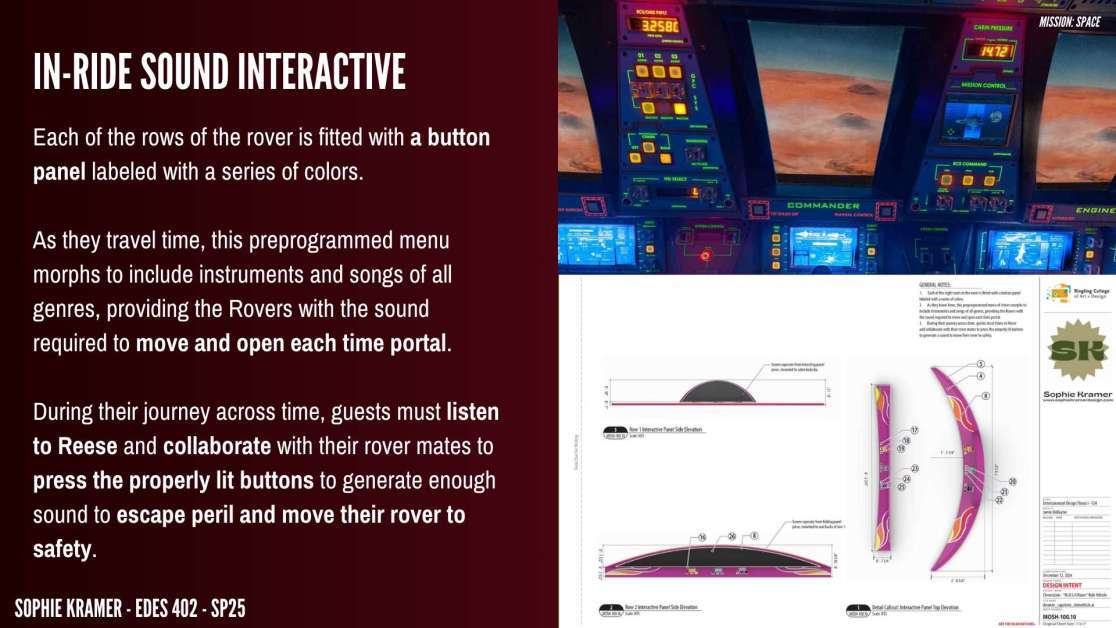
The M.O.S.H. Rover also utilizes the revolution system’s onboard gaming system to create a sound-based interactive experience for guests while riding Chronojam: a Rhythmic Odyssey. Each of the rows of the rover is fitted with a button panel labeled with a series of colors. As they travel through time, this preprogrammed menu morphs into instruments and songs of all genres, providing the rovers with the sound required to move and open each time portal. During their journey across time, guests must listen to Reese and collaborate with their rover mates to press the properly lit buttons to generate enough sound to escape peril and move their rover to safety.

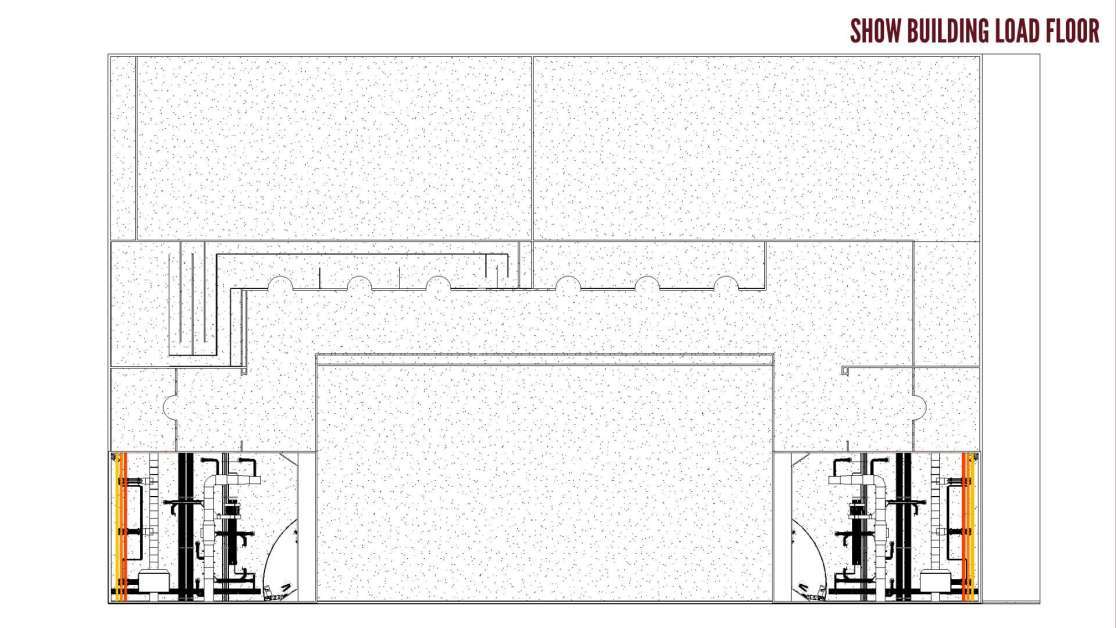
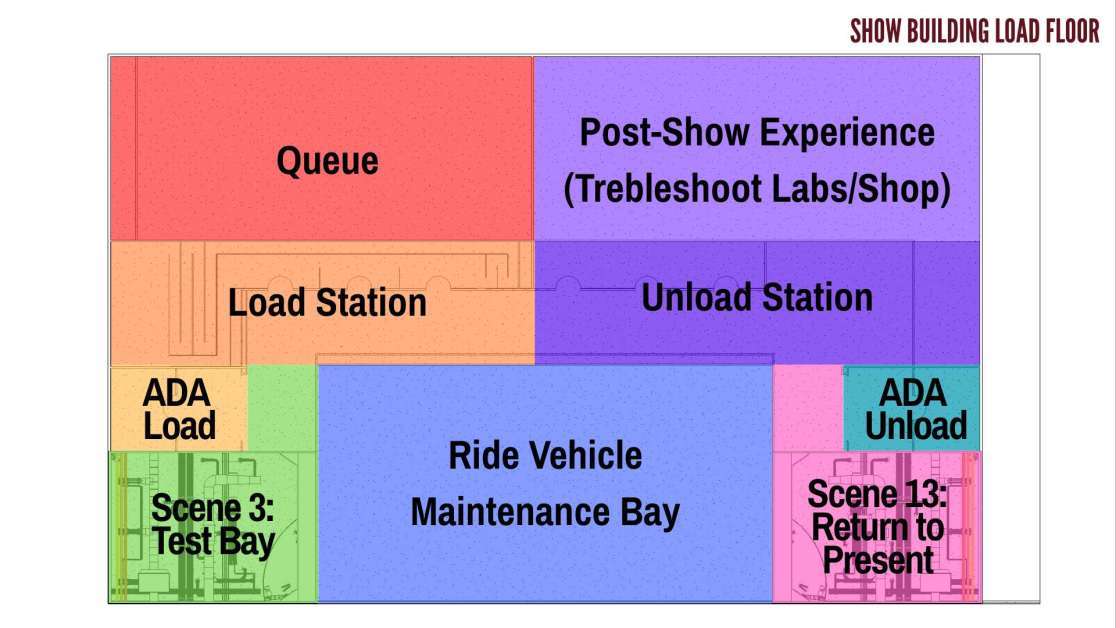
Show Building Floor Plan
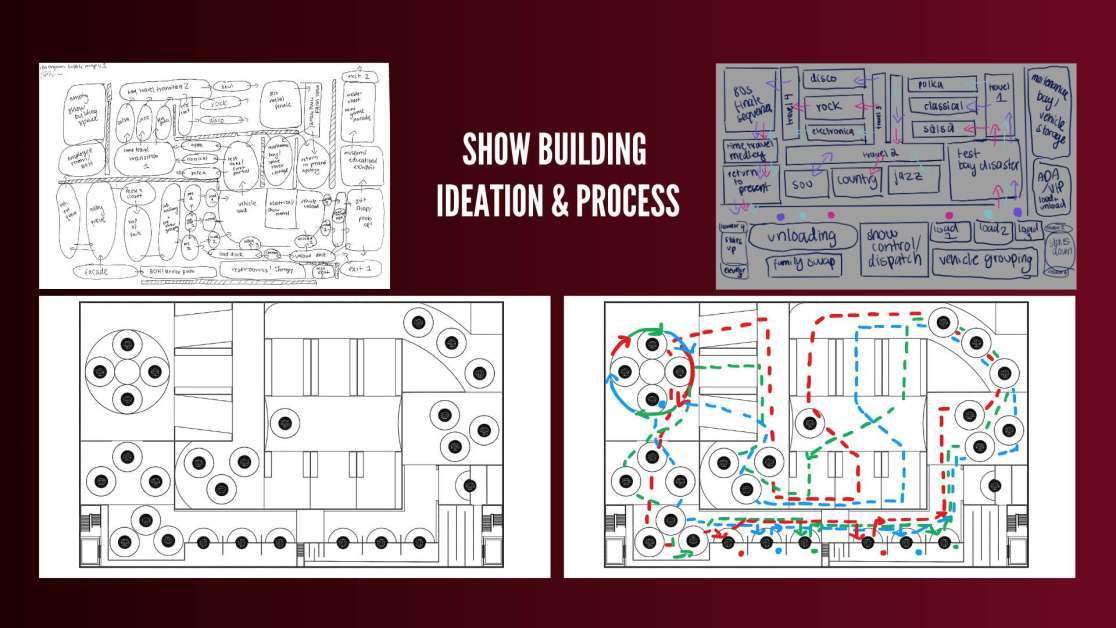
Floor planning this show building required a lot of research, exploration, and refinement. Eventually, it was clear that this attraction required a two-story 100,000 sq ft show building. One floor covered the queue, load/unload stations, CGDD-related show scenes, and post-show experience, while the other held all of the time travel and transitional scenes. In theory, to transition between these separate floors, the elevator floors lift and lower the ride vehicles between floors, as effects and lighting misdirected the guests.
From my initial sketches, I brought my floor plans into AutoCAD, Revit, and SketchUp to determine the placements of show scene elements, including the safety envelopes of the ride vehicles, ceiling heights, and more.


Show Set Exploration and Renders
Using the schematics from the floor plans I created, I brought that information into SketchUp and created dimensioned models of the test bay transitional scenes, the time travel options, and the 80s finale sequence. In further development, these key renders of the show scenes would provide informational tools and references for CAD modelers, show set designers, lighting and FX designers, and facility modelers as they began their work processes.
One technical issue I faced during this project was my SketchUp file corrupting a week before the final due date, causing me to lose 2 weeks of work. Unfortunately, due to this data corruption, I lost much of the modeling, texturing, and lighting I had done for the majority of my show scenes. In the face of these issues, I remodeled much of the missing scenic elements that I could, but I could not recover my lost textures. Due to this, and my limited time, I made the executive decision to present my fly-throughs of each scene as a white model, using the previously captured renders from before the corruption as my key shots. Although this loss was unfortunate, I am still very proud of these fly-throughs and enjoy how they can bring viewers right up to the architectural and set dressing details I included in each show scene.
The Test Bay

Guests are loaded into their Rover vehicles. While waiting for Dr. Sonata, Reese, a middle-aged janitor, accidentally slams his body into the main Rover control panel and initiates a hidden time jump procedure. This sudden launch causes the rovers to spin crazily, while the giant screen reveals Dr. Sonata’s secret plans to steal and sell important musical artifacts. Trying to stop the machines, Reese mindlessly slams buttons— sending guests spinning right into a giant time portal rapidly growing beneath
Classical Sequence

Guests are seated in the newly opened Carnegie Hall as a massive symphony plays Tchaikovsky’s 1812 Overture, with the composer struggling to conduct his piece. Right before the climax of the piece, his baton vanishes from his hand, and he whips around madly and waves his hands. This mistakenly queues the cannons to fire at the guests, destroying Carnegie Hall. Reese and the guests in Row 1 queue a selection of Dies Irae by Verdi, and they turn to the right and hightail it out of there and through the portal.
Polka Sequence
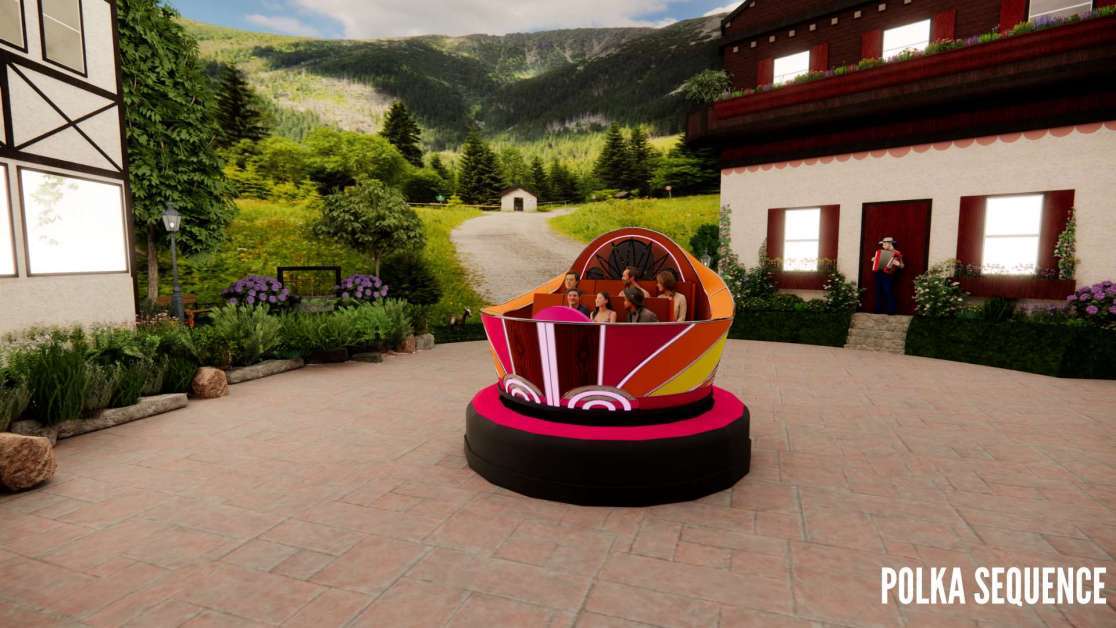
Spinning into 19th-century Poland, guests find themselves in the middle of a filled village square as rich polka music plays! We whirl and twirl around the city center with a hearty yodel underscoring every twist until the accordion vanishes right from a player’s hand, causing the yodeling man to have a significant voice crack. Reverberating off the mountains, we feel the earth start to rumble around us, and suddenly, a rockslide avalanche comes tumbling down the path towards our little village. Reese instructs the guests in Row 1 to hit the lit button, and a jaunty organ tune blasts out the speakers, sending the rover spinning and into the next scene.
Salsa Sequence

The rovers back into a vibrant Cuban city underpass and into the middle of a switching partner salsa dance party, where everyone spins around and moves their hands to the beat. Everything is swimmingly until the drums vanish from the band’s platform, and everyone falls over as the music stops. Everyone angrily stands back up, and they sadly step in silence as the beat has vanished. The guests in row 1 hit their buttons, and a hand clap pattern rings out, reuniting the aimless dancers with some kind of rhythm as the rover spins into the next scene.
Jazz Sequence

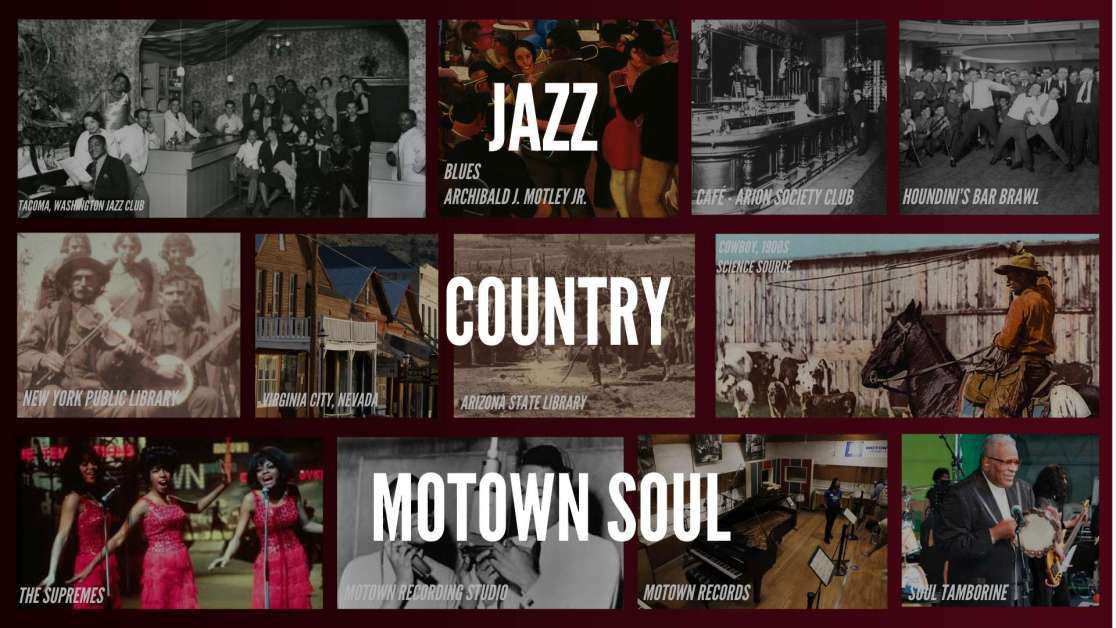
The rovers slide into a prohibition-era speakeasy as a jazz quartet performs for a crowd of curious characters. All is well as flappers dance and drinkers booze it up, but when the trombone slide vanishes from the performer’s hand, he flies forward and hits an Al Capone-esque mobster right in the face. The gangsters’ goons smash their bottles on tables, and a full-out bar brawl begins. Sirens can be heard in the distance, and the button in row 2 guests hit begins to harmonize with them as they move into the next portal without being detected by the battling gangbangers and trombone.
Bluegrass/Country Sequence

In the middle of a cattle farm, the guests listen to the ranchers sit on the farmhouse porch and play a tune for them and the cows. When the banjo vanishes, the player is so shocked that he falls off the wall, and his gun goes off in its holster, scaring the cows and causing a stampede. We spin around with the cows as they break loose and storm into town, destroying buildings and causing a major dust storm, which engulfs the rover. Desperate to turn on the windshield wipers to try and see, Reese tells Row 2 to hit a jamboree medley of washboard, bass, banjo, and more, causing us to make a sharp left turn and head into the portal.
Motown Soul Sequence

We roll into the mixing lab of a Motown-esque recording studio as a Supreme-type girl group stands behind the mics and performs their hearts out into the mics, accompanied by their tambourine. The rover bobs to the beat of their funk tune when suddenly the tambourine vanishes, and the percussionist girl’s hand smacks into the other girls. Angered by the sudden violence, the attacked girls start swinging at the others and yelling in their rich tone into the mics until they create feedback. Trying to get this horrible sound to stop, Reese orders the guests in row 2 to hit their buttons, which blasts a funky bass riff at high volume to drown out the catfight in the background.
Classic Rock Sequence
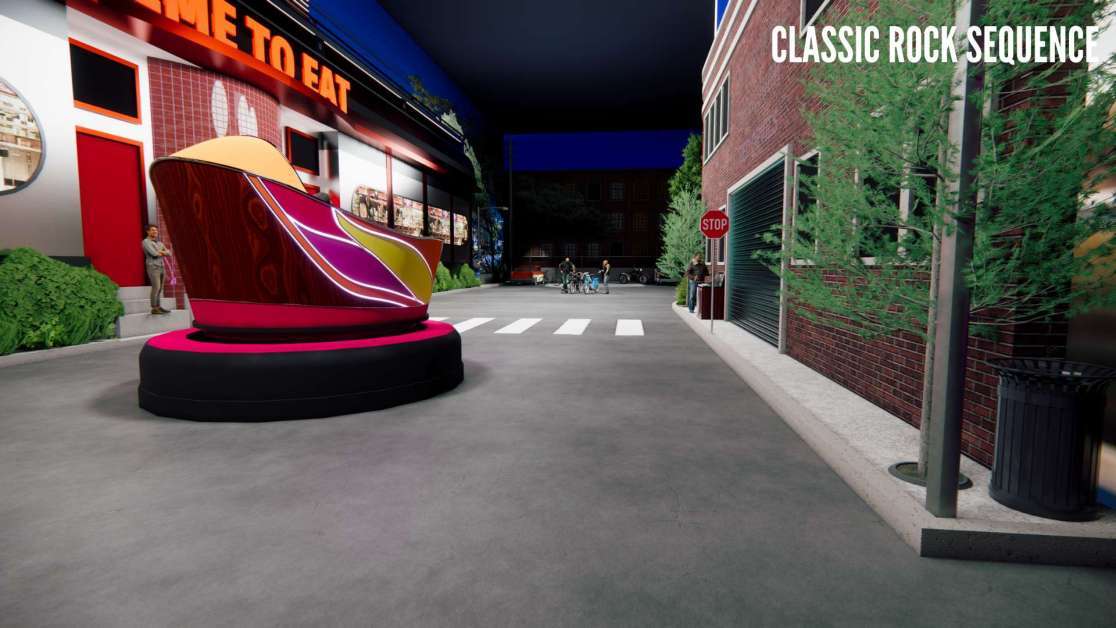
The rover parks itself at a drive-up diner, similar to the now-defunct Hob-Nob Diner in Sarasota, FL. Groovy tunes play over the speakers from the band in the corner as kids dance to the sockhop and sip on milkshakes in peace. The shiny jukebox vanishes, the music becomes dissonant, and the bikers begin to get angry in the eventual silence. The greasers jump on their bikes, drive circles around us and the band, and sneer with classic-period insults about the bad music of our lousy ride. After the third-row guests hit their buttons, a surf rock riff plays loudly as the rover begins to do donuts, causing a cloud of smoke to rise. Undercover, we back out from the bikers and into the portal as they yell one last curse at us.
Disco Sequence

Guests are dropped onto the middle of a brightly lit-up disco dance floor, and a beautiful disco queen twirls and whirls to the music ahead of us. Noticing the rover, she challenges the guests to a boogie battle. We hold our own for a bit, garnering some cheers from other disco goers, but when the vinyls vanish from the DJ’s turntable and the music skips, everyone is thrown off their groove. Sad that their dancing was ruined, people cried over their new lack of rhythm. Reese has the rover spin around as the button pressed in row 3 emits a funky bass riff, and they spin right off the dance floor and into the portal.
Electronica/EDM Sequence

Instead of entering a historic club, the guests find themselves in a bright, shiny utopia filled with robot companions, flying cars, and metallic solar panel trees. Suddenly, Reese hops onto the speaker and excitedly informs the guests that they have jumped far ahead to 2136! The rovers spin with delight as Reese hums a happy tune, and we face a robotic DJ who attracts a robotic crowd with his funky moves as he spins some techno tunes on his junkyard holo-disc turntables and battles against another DJ across the room. Suddenly, the holo-discs vanish, and the DJ robots spark and power down. As the angry robo-crowd charges up their blasters, Reese orders the guests in row 3 to hit their buttons, which play a harmonic series of beeps, sending us out of the robots’ fire lines and into the opening portal next to us.
80s Finale Sequence

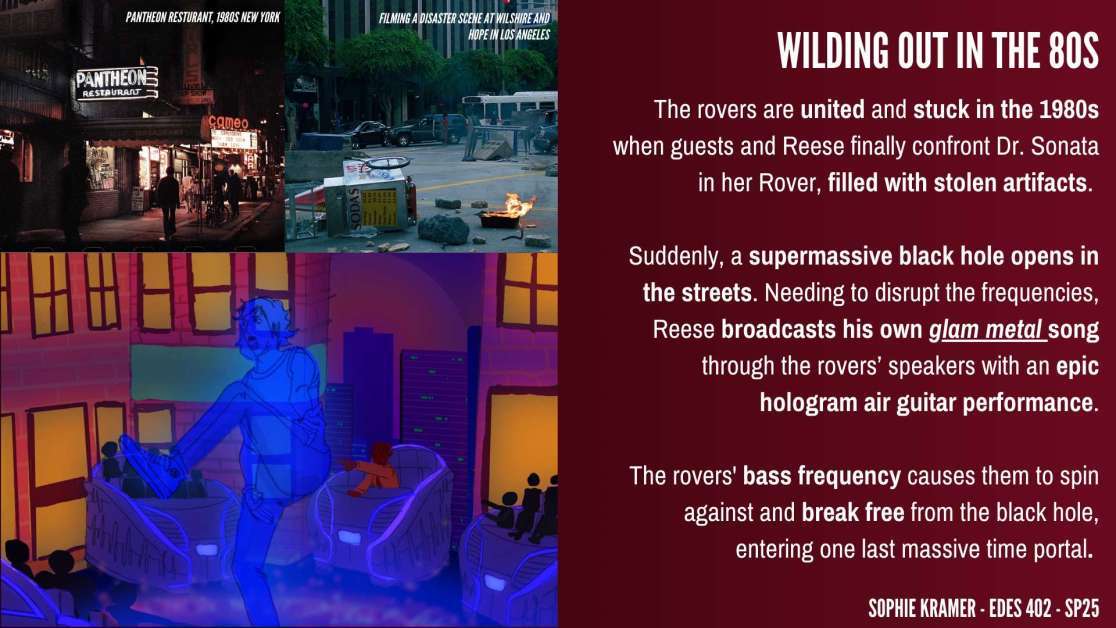
The rovers are united and stuck in the 1980s when guests and Reese finally confront Dr. Sonata in her Rover, filled with stolen artifacts. Suddenly, a supermassive black hole opens in the streets. Needing to disrupt the frequencies, Reese broadcasts his glam metal song through the rovers’ speakers with an epic hologram air guitar performance. The rovers’ bass frequency causes them to spin against and break free from the black hole, entering one last massive time portal.
Reflection
ChronoJam: A Rhythmic Odyssey was a true joy to work on and deliver to the world! While my time at Ringling College has ended, I will never forget the thrill of the first pitch, the many late nights in the labs, and how proud I was to share the final product with the Ringling (and now themedattraction.com) community. The main goal with this attraction was that no matter what path their Rover takes on this humorous and action-packed journey, guests will leave with a newfound appreciation for the excitement of music history and fond memories of their time rocking around the clock. Hopefully, after reading this lengthy diatribe, you too will do just that. Thank you for rocking around the clock and spending some time with ChronoJam! ROCK ON!




Join us
Comments