

A botanical garden is the hardest venue to light a lantern festival in, and the easiest to damage. The trees are the attraction, the beds are curated, the irrigation is buried, and the ground has been amended for decades. A light trail that ignores any of those three things will be asked back once.
We have built trails inside gardens in Nice and Montreal, and the constraint that shaped both was never the lighting design. It was the planting.
Here is what decides whether a garden trail survives its own installation.

Nothing gets trenched
The instinct on a night trail is to bury cable. In a garden, that is usually the wrong answer, because the first forty centimetres of soil is where the roots and the irrigation live.
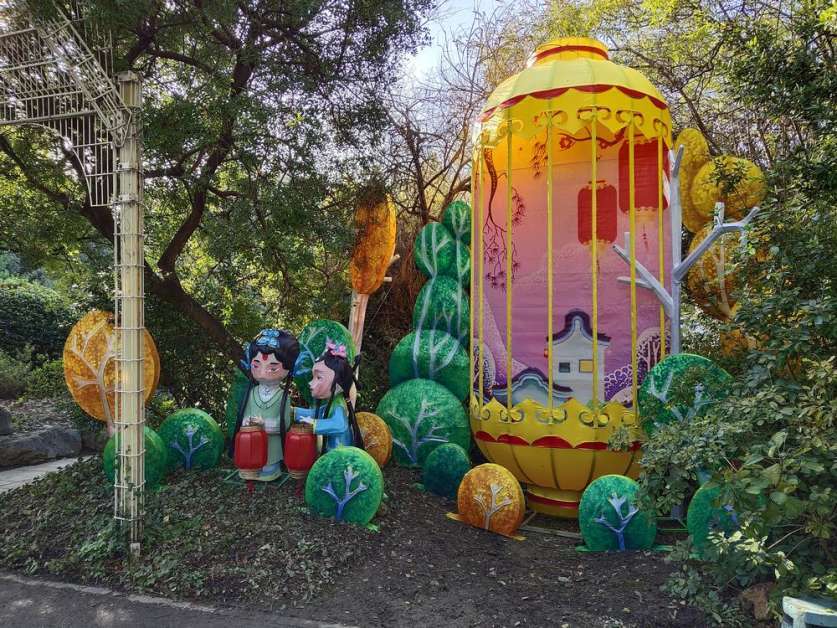
Above-ground cable routing along existing paths solves most of it. The cable runs in a shallow channel at the path edge, covered by the same gravel or bark the path already uses, and crosses beds only where a hard surface already exists. Where a piece stands in the middle of a lawn, the base is a ballast system rather than a footing: mass on the surface, no excavation, and a load plate sized so the grass underneath is shaded rather than crushed.
The ballast calculation is not the same as a wind-load calculation. A piece that is stable in a wind tunnel can still fail on wet turf, because the failure mode is the base sliding rather than the structure bending. Both numbers have to be checked, and the ground condition at the site — not the specification sheet — sets the ballast mass.
Irrigation is the invisible constraint
Every garden has an irrigation layout, and it is rarely on the drawings a client sends. It matters because a lantern base placed over a sprinkler head either blocks the water or, worse, sits in a puddle twice a week.
The practical move is to map the irrigation before the layout is fixed. On a recent trail we walked the route with the head gardener and marked every pop-up head and drip line on the plan. Two pieces moved three metres each, and nobody had to dig anything up mid-installation.
Where a piece has to sit over a line, a raised platform on adjustable feet clears the head while keeping the load spread. The feet are the part that gets specified last and matters most.
Mature trees are tied, not fixed
Nothing gets screwed into a tree that is older than the person specifying it. On a garden trail the trees are usually the reason the site is a destination, and a fixing hole is permanent.
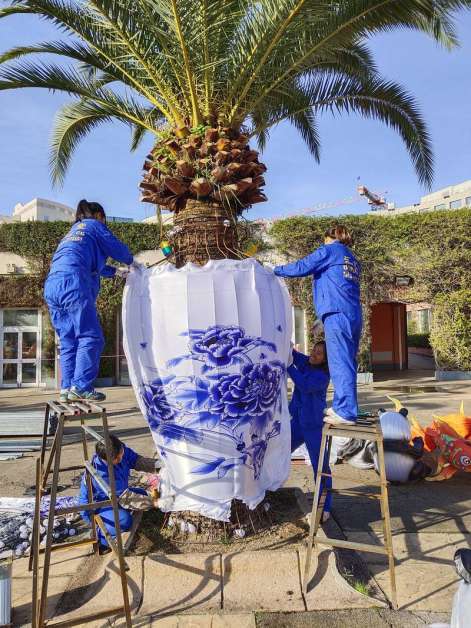
The workable method is a padded strap around the trunk or a primary limb, with the load taken by a separate frame standing on its own base. The tree provides lateral stability, not vertical support. On a tree with a canopy span over eight metres, the lit element hangs from a frame that is independent of the trunk, so the only contact is the strap.
That also solves the pruning problem. A frame that stands on its own can be moved for the annual prune without rewiring anything.
Turf survives or it does not
Grass under a trail takes three hits: shade, foot traffic, and the weight of whatever sits on it. A season is enough to leave a route that reads as a scar from the air.
Two things limit the damage. First, the route follows hard surfaces wherever possible and only crosses turf where it has to. Second, any piece standing on grass sits on a load-spreading plate with a gap for air, and the plate is moved a few centimetres every few weeks so the same patch is not shaded for the whole run.
Where a route has to cross a lawn repeatedly, a temporary track of ground-protection matting does more than any amount of reseeding later. It is unglamorous, and it is the difference between a site that invites you back and one that does not.
Route legibility matters more than the biggest piece
Garden trails fail at junctions, not at the hero piece. A visitor who cannot tell which way the route goes at a fork stops walking, and a stopped visitor is a visitor who leaves early.
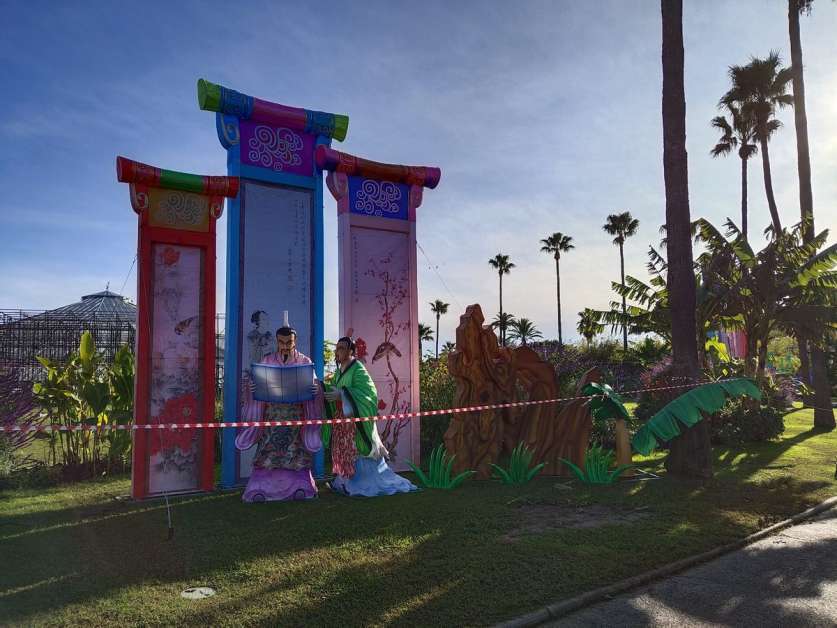
The wayfinding piece at a junction has to read at forty metres, not five. That is a different design problem from the lantern itself: high contrast against dark planting, a clear silhouette, and light that does not spill into the route behind it. On a garden trail, a modest piece placed well at a fork does more for dwell time than a larger piece placed for photographs.
The light itself can damage the planting
This is the part that gets skipped. Continuous bright light on a shrub through a whole winter changes its growth cycle. Deciduous species can be pushed into bud, and evergreens under constant illumination show stress by the end of the season.
Three rules keep it manageable. Light is aimed at the lantern, not the planting — a shielded fixture with the beam contained inside the sculpture does most of the work. Anything within two metres of a specimen plant runs on a shorter nightly schedule. And the route avoids lighting the same bed for consecutive seasons, so no single planting gets two winters of continuous light.
None of this is visible to a visitor. It is the difference between a garden that hosts a trail every year and one that hosts it once.
The de-rig is part of the design
A garden trail has to leave the site as it found it, and that requirement starts at the drawing stage. Every base is designed to be lifted rather than dug out. Every cable run has a documented route so it can be pulled back in the same order. Every strap comes off a tree without leaving a mark.
On the Parc Phoenix trail in Nice, the installation ran 87 nights through the winter and the garden reopened to normal use afterwards. The same method was used at Gardens of Light at Montreal Botanical Garden, where the route runs through a working collection rather than a cleared event space.
What this means for a garden operator
The lighting is the visible part and the easiest part. What decides whether a garden trail is a one-off or an annual fixture is how the installation handles roots, water, trees, turf and light spill — all of it invisible in the photographs.
For the procurement side — route length, piece count, and how a garden brief differs from a park brief — the botanical garden lantern festival planning guide covers it in more detail.
Ask any supplier three questions before signing: how the bases are anchored without excavation, how the irrigation was mapped, and what happens to the planting under continuous light. The answers tell you whether they have built in a garden before.
The installations referenced here were delivered by Zigong lantern makers who build garden and zoo trails.






Join us
Comments