
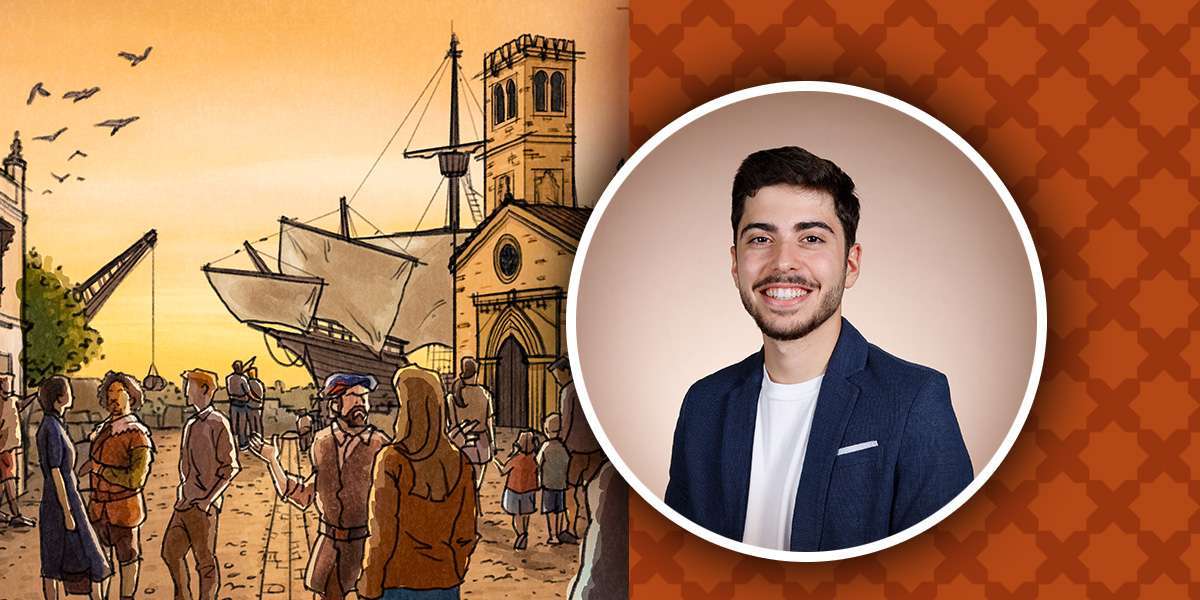
After years designing attractions for major theme parks, Orlando-based production designer Juan Bonillo is applying the techniques of themed entertainment to a different challenge: bringing his hometown’s 3,000-year history to life.
What if exploring a city’s history felt less like visiting a museum and more like stepping into another world? Imagine wandering through Roman streets, entering an Andalusi palace or finding yourself among the ships of Seville’s Golden Age, all within a single attraction. This is the idea behind Seville: A Journey Through Time, an ambitious cultural attraction concept conceived by Juan Bonillo, a production designer at Orlando-based Basemint Creative.
Drawing on his experience in the themed entertainment industry, Bonillo proposes a different approach to presenting cultural heritage: replacing conventional exhibition halls with fully realized historical environments, where architecture, storytelling, technology and live entertainment work together to bring the past to life. The project combines his professional experience in attraction design with a personal ambition to make the history of his hometown more accessible and engaging.
From Theme Parks to Seville
Bonillo’s work at Basemint Creative, a well-regarded Orlando studio, spans projects for some of the largest regional theme park operators in the United States. His experience encompasses master planning, conceptual design, attraction development, and the creative detailing of themed environments. As an industry “secret weapon” and powerful boutique firm, Basemint has earned an industry-wide reputation for putting on their guests’ hats to sculpt high-impact storytelling, consistently turning spatial challenges into revenue-generating immersive destinations.
One of Bonillo’s most prominent recent credits is Looney Tunes Land at Six Flags Magic Mountain, the Southern California park’s 2026 investment in the classic Warner Bros. characters. Six Flags’ decision to re-center a themed land around the Looney Tunes franchise, replacing two longstanding rides in the process, attracted coverage from outlets including the Los Angeles Times, USA Today, NBC Los Angeles and Blooloop.
For the project, Bonillo worked closely with the park’s creative direction and led the master plan for the land. Several attraction concepts originated with him, including the coaster Canyon Cruiser and the interactive play area Taz’s Trail Rewind, among others. “What set Juan’s contributions apart on Looney Tunes Land was his instinct for guest perspective,” says Basemint lead Josh Adcock. “From the early conceptual sketches through the realization of Taz’s Trail Rewind, he ensured every corner delivered both high-energy character storytelling and seamless park operation.”
In 2025, Bonillo also contributed to the return of The Big Bad Wolf at Busch Gardens Williamsburg. The Big Bad Wolf: The Wolf’s Revenge opened on May 23, 2025, as a successor to the park’s original 1984 attraction and part of its 50th-anniversary celebration. His responsibilities included supporting schematic design and developing custom detailing throughout the attraction.
At Herschend Entertainment, he worked on several projects, particularly Discovery Meadow at Kentucky Kingdom, where he played a key role in adapting the area’s new architectural and artistic style to its existing buildings.
Bonillo has also contributed to projects currently in development for major domestic and international industry players, including large-scale master plans and major attractions.
It is this combination of experience in large-scale attraction planning, storytelling, and detailed environmental design that informs his approach to Seville: A Journey Through Time.
Reimagining Seville’s History
For Bonillo, the idea of designing something for Seville grew out of geographical distance. Working in the United States, he encountered a standard of immersive storytelling that is commonplace in American theme parks but less frequently applied to the presentation of cultural heritage in Spain. This was an idea he had always wanted to carry out, and, after meeting a local artist with experience in recreating historical environments, Bonillo realized there was a place for the themed entertainment industry in the cultural offerings of Seville.
The timing, he argues, is right. Seville, which the European Commission named a 2023 European Capital of Smart Tourism, welcomes more than three million visitors a year. The city is also experiencing a shift toward more premium and culturally oriented tourism, with new immersive and high-end experiences opening in recent years. Among them are Luminiscence, an immersive video-mapping and music experience at the historic Church of San Jacinto, and Naturaleza Encendida, a nighttime light installation combining nature, art and technology. The hospitality sector is following suit, with luxury openings such as Serras Sevilla, a five-star hotel in a restored historic building opposite the Cathedral.
Bonillo’s proposal responds to several challenges facing the city. Seville’s summer heat limits outdoor sightseeing, creating an opportunity for substantial indoor cultural experiences. Its three millennia of layered history can also be difficult to communicate through conventional walking tours and museum displays. Meanwhile, the concentration of visitors in the historic centre raises questions about how tourism might benefit other districts. A purpose-designed cultural attraction could address these challenges while offering a premium experience that combines history, entertainment, dining and retail.
Importantly, the intended audience extends beyond international tourists. Bonillo’s ambition is to create an experience carefully tailored to Sevillanos themselves, “informing and confirming their cultural identity,” as Bob Rogers put it, while taking history off the small phone screen and making it physical for schoolchildren. There are signs of a growing appetite for this kind of cultural rediscovery among locals, reflected in the popularity of social media accounts such as Ispavilia, Paseando x Sevilla and Lost in Seville, which bring the city’s history, legends and architectural heritage to increasingly large audiences.
Inside the Attraction
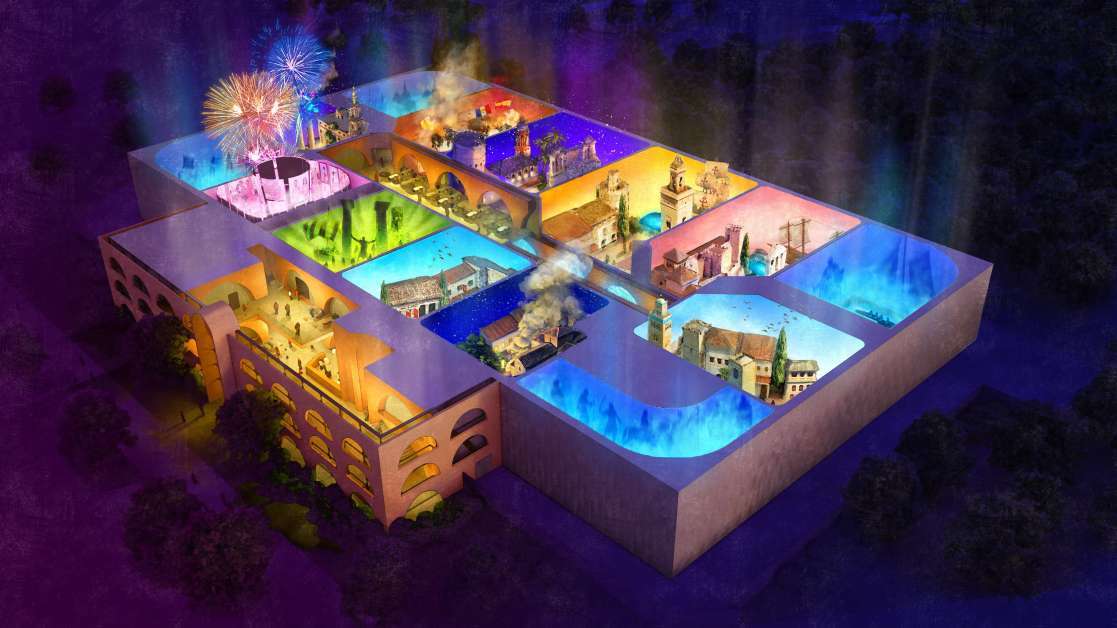
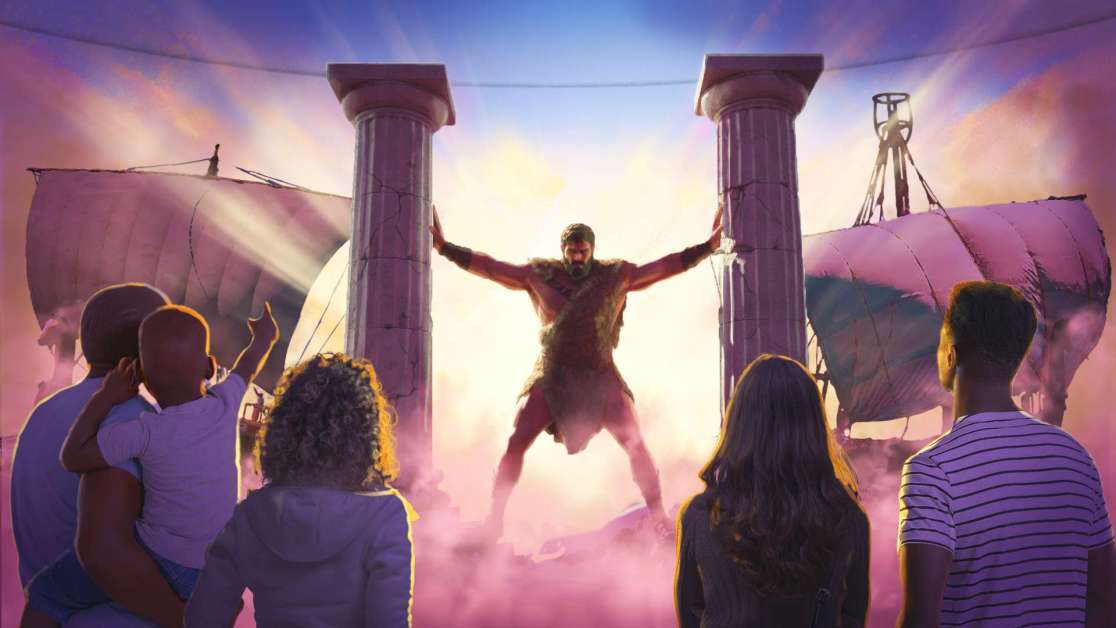
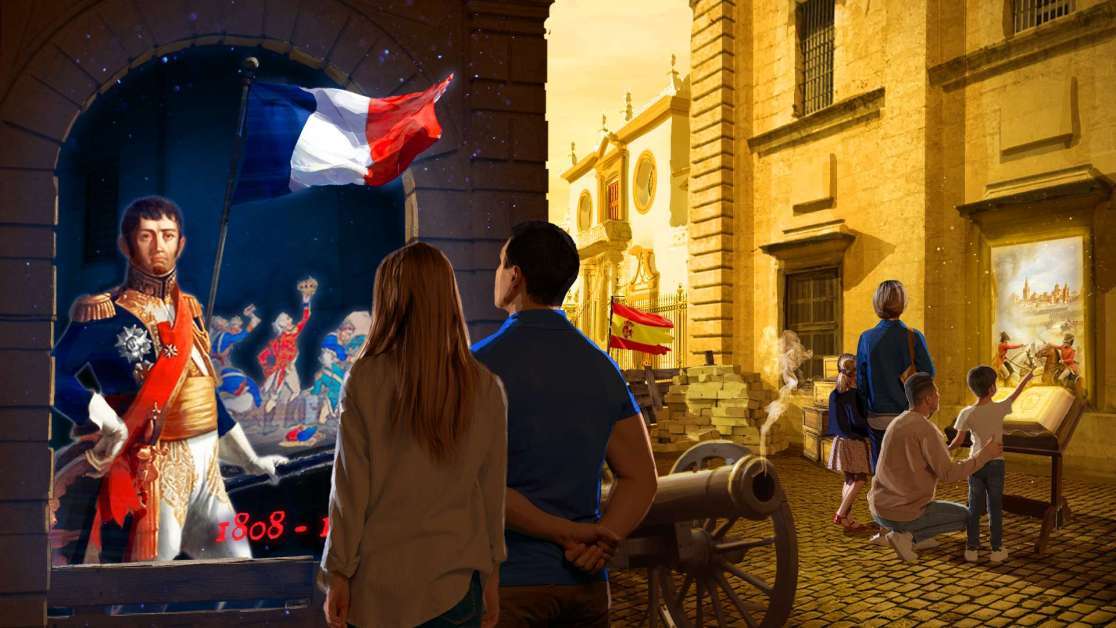
Seville: A Journey Through Time is designed as a two-level attraction organized around a central timeline hub. After an introductory preshow, visitors can freely explore ten themed environments covering the city’s history, before reaching a final room reflecting on Seville’s identity and future.
The journey spans the city’s founding myth, Roman Hispalis, Visigothic Hispalis, Islamic Isbiliya, and Castilian Seville, before moving into the Golden Century, the Baroque period, the Bourbon Crisis, and Modern and Romantic Seville, culminating in the 1929 Ibero-American Exposition and Seville Today.
A recurring river channel runs through the themed environments, representing the Guadalquivir and its importance to the city’s development. It also provides the basis for a potential future expansion: a separate boat ride tracing the river’s history through the centuries.
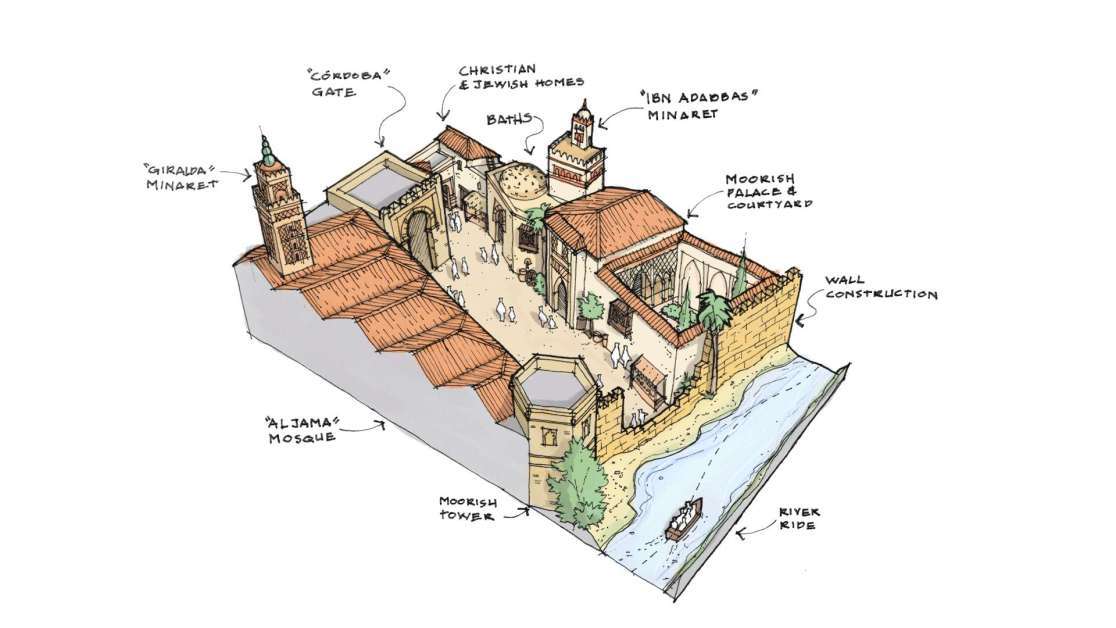
Rather than conventional exhibition halls, each environment is conceived as a fully themed space. Bonillo’s designs combine live actors, looping shows, holographic characters, projected scenes, interactive books, touch tables, and sensory experiences. An interactive audio guide would automatically deliver content as visitors explore, while a restaurant and tapas bar would extend the experience through food inspired by different historical periods.
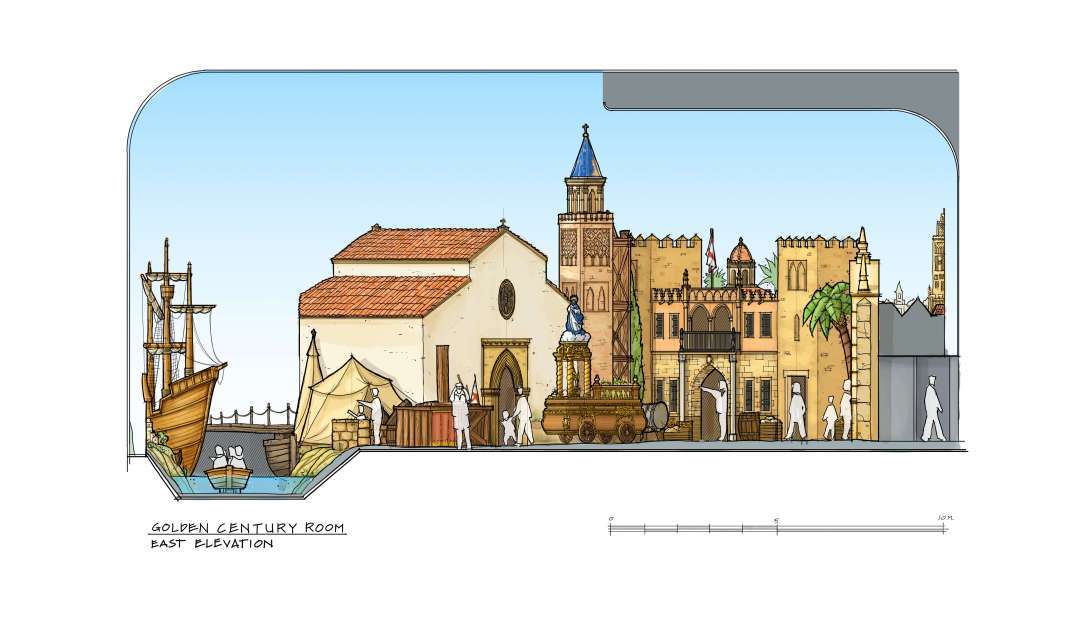
Bonillo has developed the Golden Century environment through to schematic design, producing conceptual plans, elevations, sections and detailed drawings showing guest circulation, themed environments and back-of-house operations. “This was a very interesting process that adapted techniques used in our theme park industry to a cultural setting. For example, the use of forced perspective to fit monumental structures in small spaces, or the use of projected media windows to tell stories through architecture.”
The attraction also has a complete visual identity, including a bilingual logo, colour palette, typography and distinct patterns inspired by the Tartessian, Roman, Andalusi and Visigothic periods. Intended as “a window to the past,” the identity uses a modern, restrained approach that allows the elaborate scenic environments to take centre stage.
“The biggest design challenge was creating an immersive environment that would appeal to a wide range of audiences while remaining historically grounded,” Bonillo says. “Working with experts in historical adaptation was key to accurately representing these environments, many of which have limited visual references. They also played an invaluable role in curating the content, ensuring audiences would leave with the most complete and accessible understanding of Seville’s rich history.”
Industry and Historical Perspectives
The concept has drawn endorsement from one of the best-known figures in the themed entertainment industry. Bob Rogers, founder of BRC Imagination Arts, first encountered the project when it was still a concept.
“It was a beautifully choreographed walk through history, combining food, architecture, retail, entertainment, culture, art and heart,” Rogers wrote. “Seville: A Journey Through Time is living theater. It is alive, always changing.” He added that the experience is “at once perfect for the tourist seeking the essence of Seville but also perfect for the local audience,” expressing his hope that it might succeed in Seville, “leading to an expansion of the concept serving other cities.”
Rogers is a particularly well-known legendary creator and thought leader in the field of themed experiences. He has received, among others, a Themed Entertainment Association (TEA) Lifetime Achievement Award. His perspective offers an industry assessment of the concept’s creative approach and its potential beyond a single city.
The project was also developed with input from two historical specialists. Marcos Pacheco Morales-Padrón, an illustrator specializing in historical reconstruction and cultural heritage, praised its “love, care and attention,” expressing his hope that Seville might one day have a comparable attraction dedicated to its own history. Arturo Redondo Paz, a historian and researcher of the Port of Seville, highlighted the documentary rigor behind the sketches and concepts, writing that he keeps the work “like a treasure.”
In May 2026, the project received the President’s Award for Entertainment Design at Ringling College of Art and Design’s Best of Ringling gala, the highest distinction awarded by the college. Selected personally by college president Dr. Larry Thompson, the award recognizes one outstanding project per specialty.
In Seville, the proposal has also begun attracting attention. On 19 July 2026, ABC Sevilla published an article highlighting Seville: A Journey Through Time and its ambition to bring the city’s history to life through an immersive cultural attraction, as well as the recognition the project received at Ringling College of Art and Design. The concept has also been presented to cultural institutions, including the City of Seville.
A Design Approach Beyond Seville
Bonillo sees Seville: A Journey Through Time as more than a proposal for a single attraction. Its underlying structure—a central timeline hub, independently explorable historical environments and the possibility of additional experiences such as the river boat ride—could be adapted to other cities with similarly rich histories.
The scale and investment could vary, from a 60,000-square-foot attraction to a smaller visitor centre. Each adaptation would be shaped by the host city’s historical identity, available space and ambitions, with local historians, cultural institutions and public or private investors playing potential roles.
The concept reflects a broader creative approach: using the tools of themed entertainment to make cultural heritage more accessible, engaging and emotionally resonant. Rather than simply presenting historical information, it invites visitors to inhabit the environments, encounter the people and understand the events that shaped a place.
A New Way to Experience the Past
The project’s future remains open, but its ambition extends beyond a proposal for a single attraction. For Bonillo, Seville: A Journey Through Time is an opportunity to explore how themed entertainment techniques can make local history more accessible, immersive, and emotionally engaging. By combining historical research, interactive storytelling, and innovative spatial design, the concept offers a different way of experiencing a city’s past.
For a designer who has spent his career making all kinds of stories feel real, this time the story is his own city’s.




Join us
Comments