

A Christmas installation is drawn after the show closes and taken down before the season ends. In between, the site has to run exactly as it did before: same opening time, same egress routes, same maintenance access. Most of the design work sits in that gap, not in the render.

01 · The venue does not stop being an operating site
Lighting concepts usually start with the view. Where does the guest stand, what do they see, what does the photograph look like. On open ground that is the whole brief.
Inside a park that opens at ten the next morning, the brief starts somewhere else: with four drawings that have nothing to do with how the installation looks.
The egress plan comes first, because a lit archway across a fire route is not a design decision, it is a compliance problem that gets settled by the local authority rather than by the client. Then maintenance access, because the coaster two metres behind your installation has an inspection hatch that opens every day of the year, December included. Then the pre-opening inspection route, since a duty manager walks the site roughly ninety minutes before gates and that route has to stay clear in the dark. And the drainage plan, because decorations that redirect rainwater into a queue line create a problem nobody sees until it rains.
None of these are unusual requirements. The unusual part is when they arrive — too often after the concept is signed, at which point the drawing has to be reworked instead of adjusted.
A 1.2 m clear width is a common figure for an egress route in European venues. In US assembly occupancies the calculation runs off occupant load and penalises narrow points harder, not softer. Either way the number is measured at the tightest spot, which is almost always the base of a large piece.
So put the egress and access routes on the same plan as the light layout, at the same scale, before the concept goes to render. Half the awkward conversations in a Christmas build happen because two drawings were made separately and never laid over each other.
02 · Weight above a walkway is not the same as weight on the ground
A ground-set piece is a structural question about its own base. A suspended piece is a structural question about somebody else’s structure, which is a different conversation entirely.
There are three ways to hang something over a guest route, and they behave nothing alike. Steel — a roof truss, a ride support, a purpose-built gantry — is the most predictable, provided somebody confirms the node can take the load and writes the calculation down instead of assuming it. Trees behave differently: alive, moving, and growing, with a sway amplitude at the crown that rises with height and falls with trunk stiffness. A mature tree that looks immovable in July moves noticeably in a December gust, and anything hung from an outer branch inherits that movement. Temporary trussing sits in the middle — predictable enough, but only if the ballast or ground anchors are specified against a wind load rather than estimated by eye.
Wind is the number that decides all of it. Temporary structures in most European markets are assessed against the local implementation of EN 1991-1-4; in the US, ASCE 7 governs. Design wind speeds around 25–30 m/s are a common design basis for seasonal structures, but the figure that actually matters is what the venue’s own structural engineer will sign off on — and that conversation should happen in September, not in the week before install.
As a working rule from the build side: a six-metre piece hung from four points that are properly triangulated will move a hand’s width at the tip in a steady wind. The same piece on two parallel points moves roughly twice that, and the skin starts working against the frame at the seams. Triangulation is cheaper than a heavier frame, and it is decided at the hanging plan, not on site.

03 · What the electrical load does to a building that already has a schedule
Christmas lighting lands on top of everything the site already runs: facade lighting, queue-line lighting, show systems, kitchens, and whatever the maintenance team has plugged in that nobody has documented.
Two numbers matter. The first is spare capacity at the distribution board the installation will actually reach, which is rarely the one the electrician assumed. The second is whether the circuit can be made dedicated. A Christmas installation sharing a circuit with anything operational means a fault in a decorative piece takes something else down with it, and that is the failure mode that gets a show closed rather than patched.
Protection is the part overseas suppliers underestimate. In the UK, portable equipment brought on site generally needs PAT testing and a record of it. In the US, equipment is expected to carry the relevant UL listing for its use, and an inspector will ask. Residual current protection — RCD in British usage, GFCI in American — is not optional on an outdoor temporary installation in any market we have worked in. Neither is a sealed enclosure at every connection point that sits below waist height, because that is the one a guest can reach.
A 300 m route with mid-size pieces and LED modules typically lands somewhere in the low tens of kilowatts once drivers and control are counted. That is not a large load. The complication is never the total, it is distributing it across a site where every available board is already partly used, and doing it without a temporary cable crossing a route guests walk on in the dark.
04 · The overnight build and the morning open
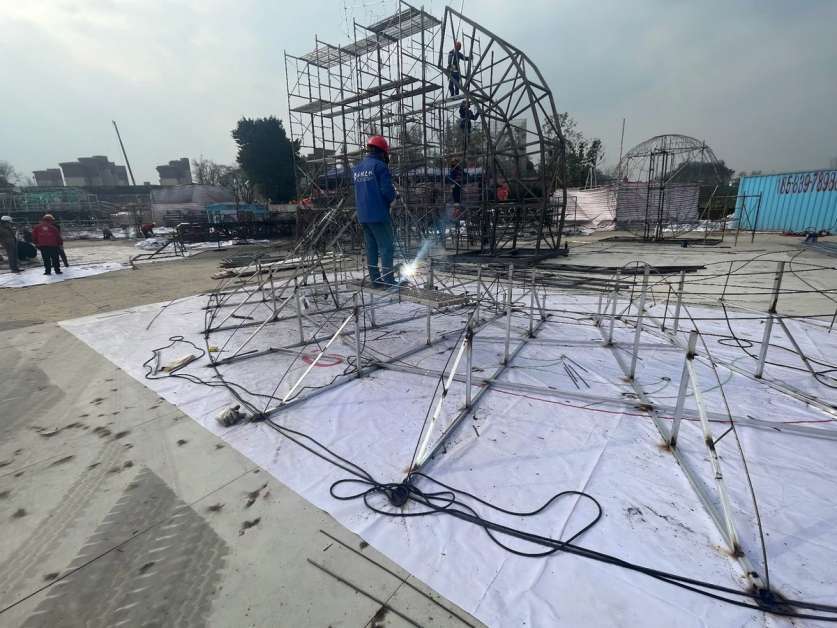
Installation windows in an operating park are counted in nights, not days. A site that closes at six and opens at ten gives eight hours of workable time, and two of those are lost to setting up and clearing away.
A 300 m route, roughly forty pieces, with six to eight of them large enough to need lifting equipment, is a three-to-four-night job for a crew of eight to twelve, assuming the crates are on site and the layout is marked. The sequence that keeps it inside that window is always the same: structure first, skin second, lighting third, test last. Trying to save a night by skinning pieces on the ground and lifting complete assemblies sounds faster and usually is not, because a skinned piece is a piece that can be damaged during the lift.
The rule that matters more than speed: every night ends with the site handed back. Nothing left across a walkway, no cable on the ground, no unsecured panel at head height. A crew that has worked in operating venues does this without being asked. A crew that has only worked festival grounds will tell you it will be finished tomorrow, and tomorrow is when the park opens.

05 · What gets stored, and what gets thrown away
Christmas is an annual event, which makes storage a design requirement rather than an afterthought. Pieces built as one welded assembly look efficient in the workshop and become a problem in February, when they have to go somewhere for eleven months.
What works is sectioning at the design stage: splitting each large piece at points that fit a standard crate, numbering every section so it goes back together the same way, and producing a crate list that matches the layout drawing. Silica in the crate is not a detail. A container that sits through a humid summer with residual moisture in the skin will come out with mildew along the seams, and that shows up in the second season, not the first.
The split that matters in February is between structure and skin. Frames, bases, and hanging hardware go back into store with an inspection list. Skin, paint, and any printed element take the weather, and they are worth checking properly before each season rather than assuming they will hold.
06 · Three questions to settle before the concept is drawn
Not a checklist for the lighting designer. A checklist for whoever signs the concept off.
Where does the guest walk in daylight? If the answer is not on the drawing, the installation will be adjusted on site. On-site adjustment during a night build is how things get broken.
Which access points must stay operable? Name them, mark them, give each one a clear zone. A maintenance hatch that needs a metre of clearance is a constraint, not an inconvenience.
How many nights is the takedown? If nobody has answered this, the return leg has not been planned, and the venue lives with a half-dismantled installation through January.
Those three answers do not make a design. They give one something to be measured against, which is the difference between a scheme that survives contact with an operating site and one that gets cut back in the week before opening.
FestiveLanterns builds large-scale illuminated displays in Zigong, China, and installs them on sites across Europe and North America. Two related reads: how a night trail is engineered for wind and ground fixing, and what happens to the pieces between seasons.
Zigong Huilongtang Culture & Art Co., Ltd.
自贡市汇龙堂文化艺术有限公司
festivelanterns.com


Join us
Comments