
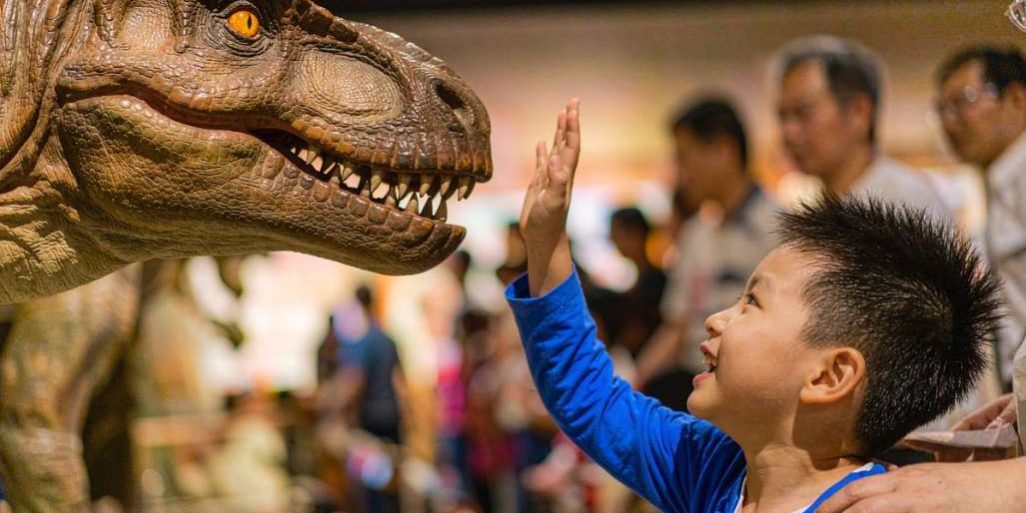
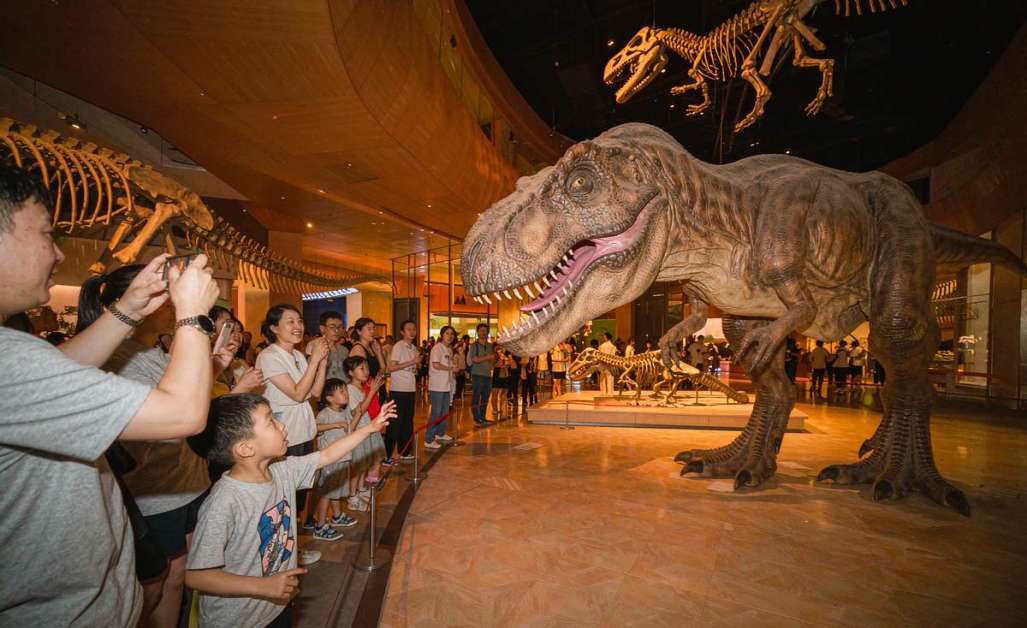
Ask a family what they remember about a dinosaur exhibit and they rarely describe the animal. They describe the moment their child waved at one and it turned to look back.
That distinction has quietly become the dividing line between exhibits that fill a museum night and exhibits that sit empty by the second season. An animal that performs on a fixed loop is furniture with a pulse. An animal that notices a visitor, and lets the visitor see that they caused the reaction, becomes something a family plans an evening around.
The change is not mostly about bigger animals or better sculpts. It is a handful of design decisions about how the animal senses, how fast it moves, and what an operator can do with it after installation. Four of them do most of the work.
What a static animal actually costs you
A dinosaur on a fixed cycle is a ninety-second stop. A family photographs it, the child loses interest, and the group moves on. The animal itself has not failed; it was designed as an endpoint rather than a trigger.
For an operator programming a museum night or a themed event day, that is the expensive kind of failure. You have paid for a headline object that empties the room as fast as it fills it. The exhibits that anchor an evening event are built as a sequence: the animal is the hook, and something the family does next is the reason they stay.
Change one: the animal has to notice someone
The single biggest lift in family engagement comes from adding sensing, and the reliable versions do not use cameras. Ultrasonic motion detectors paired with infrared proximity arrays, mounted in the head or chest, read a visitor inside roughly a three-metre zone: how close they are, how fast they approached, whether they raised a hand or stepped forward. We break down how gesture-sensing animatronics read body language in more detail elsewhere.
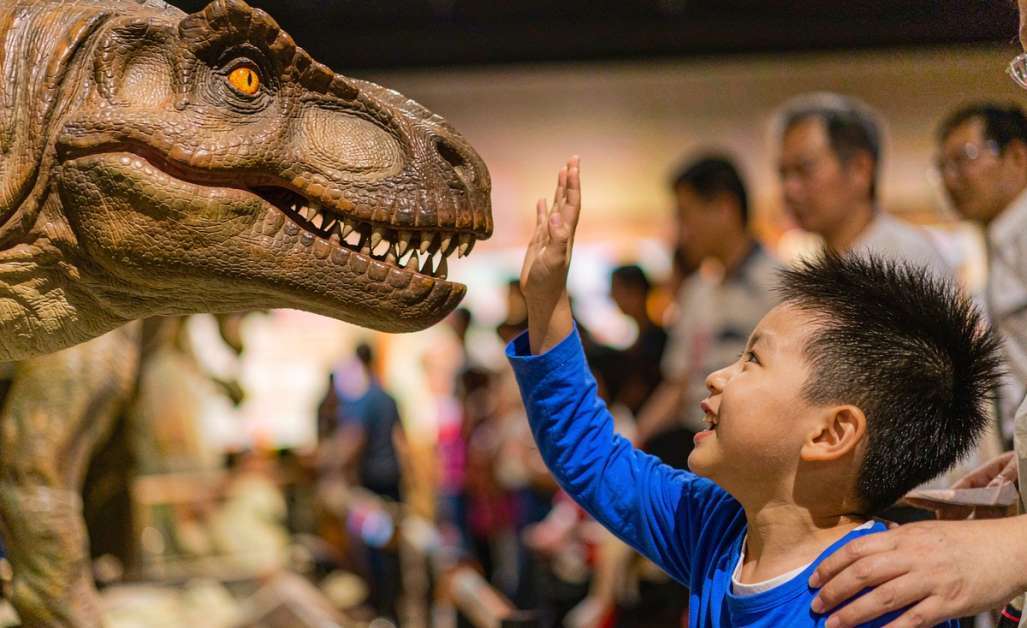
Why this matters for families specifically is that the reaction is legible to everyone watching. A child waves, the head tilts, the eye colour shifts, a soft vocalisation plays. The crowd behind the child sees the cause and wants a turn. Gestural formats, where a raised hand makes the animal lift its head, reliably produce the longest queues, because onlookers can see that the visitor commanded the response rather than merely walked past a sensor.
Change two: child height means slower and quieter
Here is the mistake most easily made in family venues: running the same behaviour profile for a standing adult and for a child at chest height. A jaw that snaps or a head that whips round reads as a threat at a metre and a half, not a greeting. At child height, movement has to run slow and quiet, or the exhibit frightens the audience it was built for.
The fix is partly mechanical and partly programming. Detection is set between one and three metres from the animal, close enough that the reaction feels personal, far enough that small visitors are not standing inside moving parts. Smaller pieces lean into touch: a baby dinosaur puppet or a cuddly triceratops that lifts its head when patted. Children understand that mechanic instantly, with no sign and no staff member explaining it. Pressure mats under a fossil-dig station work the same way. The guide to interactive exhibit formats covers the sensing options in greater depth.
Change three: build several responses, not one
A single reaction is a novelty that expires. Animals that hold up across an evening run multiple behaviour profiles: a short acknowledgement for one visitor passing through, a longer sequence when a group gathers, and a genuinely different mode for a scheduled show.
One of our gesture-activated tyrannosaurs carries sixteen profiles, from a gentle family setting with soft head turns and quiet calls through to a theatrical full roar. The operator chooses the register to match the moment, calm during general opening hours and dramatic at the advertised show time. That range is what lets the same animal serve a school group at three in the afternoon and a museum-night crowd at seven.
Change four: make the animal programmable by a presenter
The most useful format for event programming is operator-driven. A presenter runs the animal from a handheld controller, timing the reactions to a story and responding to one specific child in the audience. This turns the dinosaur from an exhibit into a scheduled act, something an events team can advertise, build a queue around and repeat.
It also changes the economics. A photogenic set piece, such as a life-size tyrannosaur head that reacts to a visitor seated in a jeep cockpit, gives families something to take home: children lean out of the window, the animal lowers its jaw, and the photograph travels outward on social media. For a themed event day, that is reach the venue did not have to buy.
Bringing the animal into the room: walk-around suits and the science class
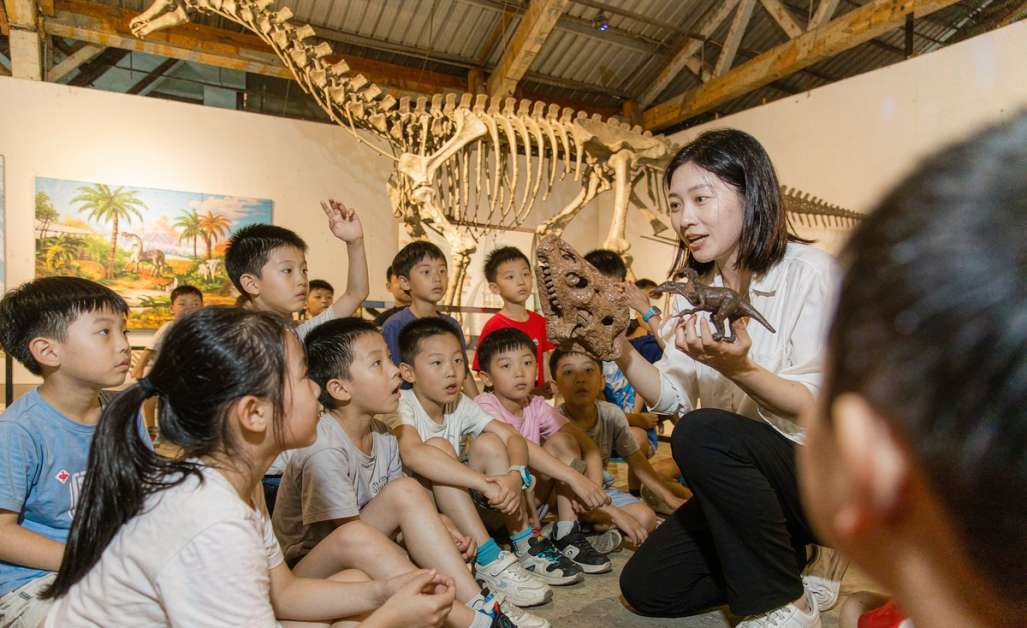
One format dissolves the distance altogether. A walk-around dinosaur suit puts a performer inside a full-size, textured animal that can step off its plinth and into the crowd, lowering its head to a child’s height and turning toward whoever addresses it. Unlike a fixed exhibit it can cross the room, pick one child out of a group and hold a moment for a photograph. It is the cheapest way to put a walking dinosaur in front of a family — one performer, one battery pack, no site preparation.
The strongest programmes make the children active rather than passive. Hand a child a baton or a wand and the suit becomes something they can direct: a raised stick prompts a head turn, a sweep prompts a roar, and the children watching can see that the reaction belonged to the child holding it. It is the same cause-and-effect loop as a sensor-driven exhibit, with a performer reading the room instead of a controller reading a proximity array, and it works because the next child in the crowd wants a turn at the baton.
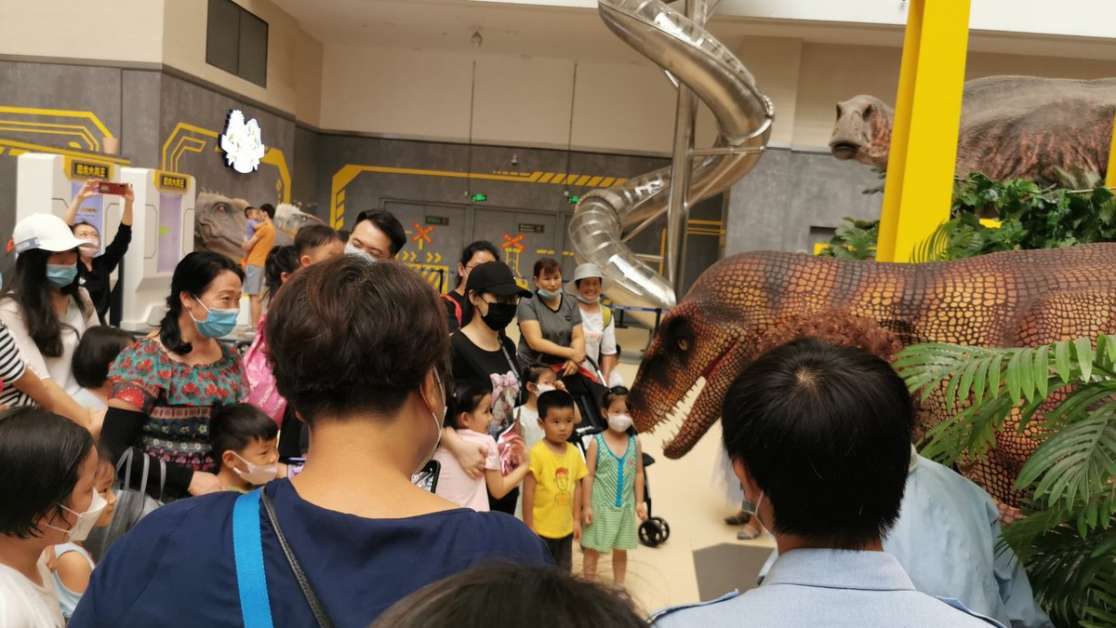
The other half of the programme is quieter and, for many venues, more valuable. A dinosaur science class — an educator with a fossil cast, a skull replica and a mounted skeleton, children seated in a semicircle — gives the visit a reason beyond the spectacle. Children handle the material, ask questions, and the animal they met twenty minutes earlier becomes the answer to something they are learning. Major Chinese attractions such as China Dinosaur Land run this kind of class as a regular fixture, and it is increasingly what parents compare when choosing between one venue and another. The exhibit supplies the memory; the class supplies the meaning.
What this looks like on a museum night
Put the four changes together and a workable evening has a simple shape. The animals sit in low light along a route, each responding as families approach. At a fixed time a presenter takes one animal into show mode and runs a ten-minute sequence; the crowd gathers because it knows something is about to happen. A touch station near the exit keeps younger children engaged while parents linger. The visit ends with a photograph the family will post.
None of that requires a larger animal budget than a conventional display. It requires that sensing, response variety and show control were specified before purchase rather than discovered afterwards.
What to ask before you order
Four questions separate a supplier who has designed for family events from one who has only built a good-looking animal:
Does it sense visitors, and can the response be seen from behind? If the reaction is invisible to the crowd, it will not build a queue.
Can the behaviour be slowed and softened for child height? Ask for the gentle profile to be demonstrated, not described.
How many distinct responses are installed, and can we program them? One loop will not survive a repeat visit.
Can a presenter drive it during a show? If the answer is no, you have bought an exhibit, not an event.
The animals are the easy part of a family event. What decides whether a museum night sells out is whether the dinosaurs were built to notice the people who came to see them.
Hongfeng Zheng is with HLTDINO, the animatronic division of Zigong Huilongtang Culture & Art Co., Ltd., which has built animatronic animals and mounted skeletons for museums, parks and aquariums in more than 40 countries since 2012.


Join us
Comments