

Senior Thesis: Mike Artwell. Interior Architecture at the Cleveland Institute of Art.
Part 1: Crafting a Year-Round Horror Park
Most of my peers studying Interior Architecture at the Cleveland Institute of Art knew they wanted to craft a senior thesis that tackled hard-hitting, real world issues like re-developing the passenger experience at an airport, creating a space where cancer patients feel at home, or sourcing organic food with love and care in a new type of grocery store. I thought to myself, “How can I apply themed entertainment to a social issue that needs to be addressed?” Escapism plays a key role in how guests interact with a themed environment. But, what if there was a way to remain inclusive to more
people without sacrificing show quality or immersion? My goal is to show how that’s possible.

The Problem Statement
The incredible innovation happening in ride and show design today often includes intense and dramatic movement that excludes guests in wheelchairs. Game changing E-Tickets deservingly receive the most praise and attention whenever a new mega land opens. Attractions like Harry Potter and the Forbidden Journey (Universal Orlando) or Tron Lightcycle Power Run (Shanghai Disneyland) push the limits of what a ride vehicle can do, and how guests interact with it. The drawback to these types of rides is that many guests cannot remain in a wheelchair in order to experience it. The American Community Survey (ACS) estimates the overall rate of people with disabilities in the US population in 2016 was 12.8%. And, this number is slowly rising. This means that within the microcosm of US theme parks, a good percentage of guests will be living with some sort of disability. My goal is to create a highly realized and thrilling experience with a ride vehicle that allows for everyone to ride.
Big Growth is IP Driven
The biggest growth is IP-driven. Innovative experiences, rides and programming are also important drivers. The big players are in a position to command the big IP. They have full awareness of the power of these franchises and to what good, creative use of IP in a storytelling environment — made immersive with state-of-the-art technology — enables them to do. According to the Aecom, attendance at the Top 20 North American Theme
Parks grew by 4% overall in 2018, a substantial increase for this mature market, representing growth of 6.1 million visits. This was notably higher than the previous two years’ increases (2.3% in 2017 and 1.2% in 2016). We can attribute growth like this to properties like The Wizarding World of Harry Potter, Star Wars: Galaxy’s Edge, and Pandora: The World of Avatar. However, there is one genre that seems to be ignored largely in the theme park design space. And, that’s horror.
Why a Year-Round Horror Environment Would Work
Horror in theme parks is an untapped treasure trove aside from annual Halloween events – like Universal’s Halloween Horror Nights – and a select few attractions around the globe – like Saw: The Ride at Thorpe Park. If we look at the return on investment for seasonal Halloween events at parks around the world, there is massive monetary value in a park having haunted houses in the Fall. In addition, box office returns for horror films are usually a strong indicator of a thriving genre as well. Horror’s dominance in film isn’t new, but I’d like to include some examples. IT: Chapter 1 grossed over $700 million in 2017, Halloween (2018) grossed over $255 million, and The Invisible Man grossed over $100 million on a $7 million budget. If we adjusted The Exorcist’s (1973) returns for inflation then the film is making $1.04 billion; that’s Marvel level interest by horror fans. In fact, if we take the top 25 highest grossing horror films of the 21st century so far, they would have made over $4.5 billion in cash. With some of these facts in mind, it’s clear to see why there is a void needing to be filled in a themed experience setting.
The Current Approach to Accessibility
There are three areas of opportunity I want to improve upon with my design. The current approach to transferring a guest onto a ride vehicle from a wheelchair is uncomfortable, and it impedes normal operations, and can take a guest out of the ride’s narrative. Let’s look at the case study of Rock n’ Roller Coaster Starring Aerosmith at Disney’s Hollywood Studios. This video footage highlights the existing policies in place to accommodate a guest in a wheelchair.
Tieing Accessibility, Horror, and IP Together
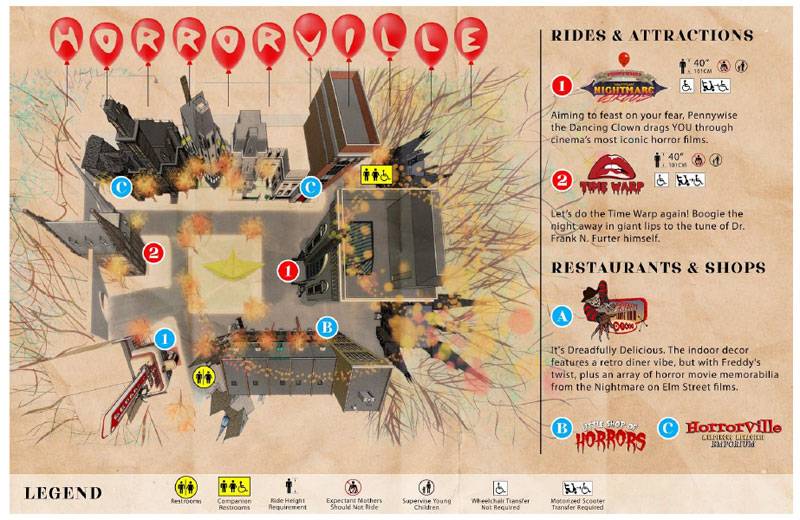
Welcome to HORRORVILLE. Within this town it’s perpetually Halloween; the leaves are always a crispy golden brown and Fall is in the air. This seemingly idyllic town square is unique because all of the buildings represent famous locations from iconic horror movies. On one corner is the fire station from Ghostbusters (1984) sitting next to the house from The Exorcist (1973). Grab a bite to eat at Freddy’s Diner where Chef Kruger would love to tuck you in. Dying for a good creature feature? Catch a marathon of horror mayhem at the Palace Theater where Pennywise’s Nightmare Circus will leave you speechless. Within this terrifying land you will find two attractions, two retail concepts, and one quick service dining location.
At witching hour you will find
The evils of this place entwined
For if you seek with half-witted heart
Your fate is sealed you’re ripped apart
Beyond these doors see who reigns supreme
And ghastly worlds to devour your screams

The E-Ticket
Aiming to feast on your fear, Pennywise the Dancing Clown drags YOU through some of cinema’s most iconic horror films. From Freddy Kruger’s boiler room to The Shining’s Overlook Hotel, the only thing you’ll have to laugh about is the irony that this is no dream, it’s a NIGHTMARE. Welcome to Pennywise’s Nightmare Circus. This trackless dark ride will thrust guests into the sewers of Derry, Maine where Pennywise the Dancing Clown has
conjured up iconic horror characters and locations within each tunnel. Riding in giant paper boats similar to the S.S. Georgie, there will be four unique types of horror films guests could see throughout the ride. There will be a Creature Feature, Science-Fiction, Paranormal, and Slasher film that are all tied together with the through line of the sewer network. Pennywise the Dancing Clown is a shapeshifter, therefore he has crafted each of these startling new environments victims of the ride will encounter. In addition, because the ride is trackless the ride vehicles will randomly choose from three possible movies in each section of the attraction. This means there are sixteen unique possible combinations of scenes guests can experience; giving a massive re-rideability to the E-Ticket. The load and unload station is a crucial element of my design for its accessibility. The space consists of a traditional duel load/unload floor and a new alternative load/unload space for guests in wheelchairs.

This alternate load/unload area mitigates the issues I found with the current approach to transferring guests on and off of ride vehicles. It doesn’t take the guest out of the narrative, it allows the guest to take as much time as they need to get in and out of the boat, and it doesn’t impede on normal operations. In addition, an accessible ride vehicle designed to look just like the traditional ones accommodates people who need to stay in their
wheelchairs. Utilizing a turntable system, the guest simply wheels onto the boat, locks into place, and then the table turns them to face forward. This seamless experience would make the process of transferring unnecessary for this type of E-Ticket.
Once guests are onboard their paper boats they will travel through the sewers where each tunnel holds a new horror experience; all cultivated by our ringmaster Pennywise. The possible films each show scene would represent all have multi-generational appeal. Featuring franchises that have been going strong for decades, like A Nightmare on Elm Street or Ghostbusters. The title character, Pennywise, has got his start in King’s novel over
forty years ago. Then, the mini series of the 1990s starring Tim Curry brought the property to the forefront for that generation. Finally, the new blockbuster movies have once again shown young people who Pennywise is. Most of the IPs I chose have this same type of longevity; some are slightly more nostalgia based. Riders will brave Outpost 31 from John Carpenter’s The Thing, escape Times Square while phantasms wreak havoc in
Ghostbusters, and come play in The Overlook Hotel in Stanley Kubrick’s The Shining; among many more close encounters.
Give In to the D-Ticket
Let’s do the Time Warp again! Antici… pate swift turns, dramatic acceleration, stopping, spinning, tilting, and jarring actions as you boogie the night away in giant lips to the tune of Dr. Frank N. Furter himself. Time Warp is a trackless indoor flat ride where the ride vehicles dance and spin to famous songs from the cult classic film, The Rocky Horror Picture Show. Come Visit a World Where IT Feasts on Your Fear HorrorVille is a permanent, year-round horror themed environment that features a thrilling and innovative E-Ticket ride that keeps the intensity without sacrificing accessibility. The land showcases and develops a high caliber, entertaining narrative that makes sense within the context of the land that has cross-generational appeal. And, it highlights the stories and characters that lack representation in themed entertainment; the horror icons of yesterday
and today.


To see the full project and more of my work, check out my website; mikeartwell.com


Join us
Comments