
Karlyn Leander – first year MFA candidate.
Small Project Studio, TPA 6158-Spring 2023. Aram Ebben
Assignment: Design a 15-20 minute mobile experience that will be profitable within 3 years
Concept
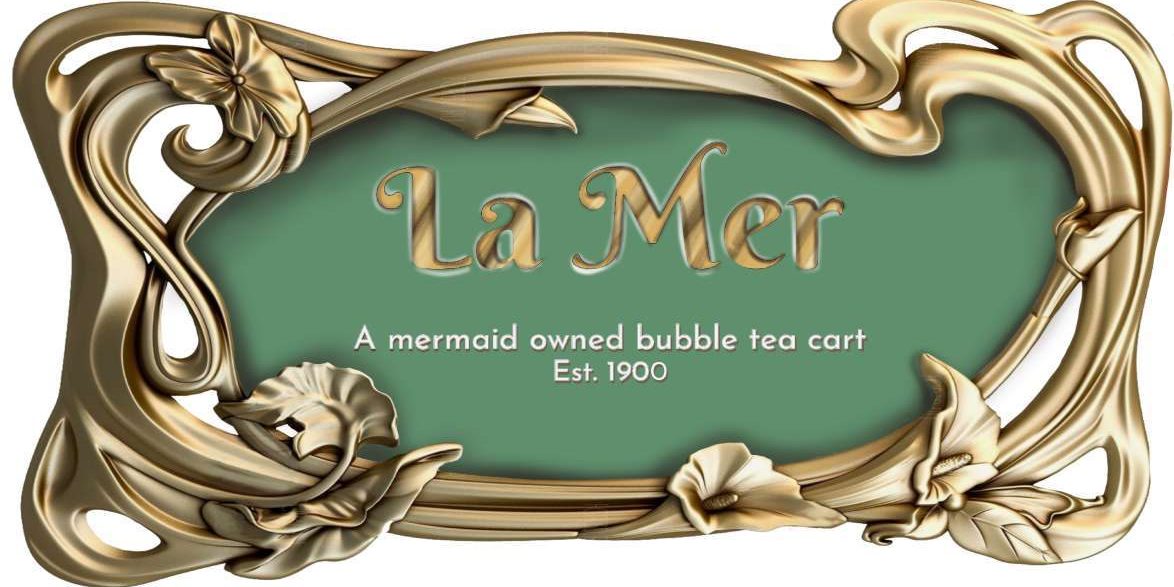
La Mer is an immersive storytelling quick service experience. It aims to enchant its guests with beautifully crafted treats and the chance to interact with a real mermaid.
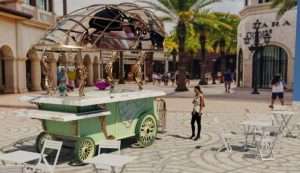
Maya rendering of La Mer parked in a shopping district
Guest Experience
La Mer is a striking elegant and whimsical bubble tea cart. Guests intuitively understand that it exists in a moment of history and is reminiscent of a sea shell. As they approach, they will notice all sorts of colorful displays of syrups, bubbles and sea herbs. The guest is greeted by a lovely mermaid. She engages them in conversation about the sea and explains some of her strange looking ingredients. After the guest has placed his order, she starts assembling the concoction. She lifts an ornate cloche in order to scoop some pink goopy pearls out of a bowl, uncorks a cordial to shake a dash of green syrup into the mix. As the guest steps back to wait for his drink, his eye catches a flick of movement. He hadn’t noticed at first, but in the side of the cart window of glass reveals tank of water. Of course, mermaids need water! He doesn’t believe his eyes. As she works, flicks of tail propel her this way and that. When she swims closer to hand him his drink a light sprinkle of water splashes over the side. He has just met a real mermaid!
Why Boba Tea?
It’s Easy, Delicious and People Love it
Often referred to as “bubble tea” boba stores offer a wide variety of colorful drinks, toppings and flavors. It’s popularity has been growing wildly for a number of years and is projected to continue to do so for years to come. The drinks are cost effective and easy to produce. They begin as a tea base and are mixed with combinations of powdered milk, syrups and toppings to produce unique flavors. The most recognizable topping is tapioca pearls which are cooked in a sugar syrup until soft and chewy. Other popular additives include jellies, puddings and foam toppings. Many of these ingredients are cheap, easy to store, and can be combined to create nearly infinite variations.
It has Untapped Theatrical Potential
A hallmark of many bubble tea stores is robotically sealed cups. Once the ingredients have been assembled, the server positions the cup within the machine which encloses and seals the contents with a waterproof barrier. This element is entirely unnecessary to the drink itself yet it has become a standard practice in stores across the world. The cup sealer constitutes a mini performance and consequently transforms a mere transaction into an experience. Although this performative aspect could create immense entertainment value, seemingly few boba stores have capitalized on its potential. By taking a theatrical approach to its production, display and consumption, bubble tea can become something far more than a mere product. Rather, it can become an immersive experience which delights its guests and drives the value of the offering to a whole new level.
The World of the Story
The Story
A troupe of friendly mermaids has traveled from their ocean kingdom to participate in the Paris Exposition Universelle of 1900. They’re excited to bring you the exotic flavors of the ocean in the form of bubble tea. Watch as they assemble the colorful ingredients into a beautifully crafted beverage and serve it in a specialty seashell traveling cup.
The Name
La Mer means the sea in French. The name was selected because it is easy to pronounce and remember. For English speakers, it immediately draws to mind the image of a mermaid. It is short and brandable which makes it easy to utilize for marketing purposes.
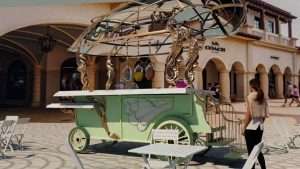
The Setting: Paris Exposition Universelle of 1900
The World’s Fair in Paris was one of the biggest and most widely attended in history (over 83,00 exhibitors). It was a celebration of innovation, progress and culture, attracting visitors from around the world. Amazing new inventions were featured including the ferris wheel, diesel engines, talking films, and escalators. The fair hosted pavilions from countries around the world. This provides the motivation for the mermaids within the story. They have traveled from their ocean kingdom to Paris in order to exhibit their native cuisine to the people of the world.
The Design Language: Art Nouveau
The Art Nouveau movement played a significant role at the Paris Exposition. Forming as a reaction against the cheap, cluttered style of the Victorian era, Art Nouveau sought to unify ornament with function creating “total works of the arts,” in which, “every element worked harmoniously within a related visual vocabulary” (theartstory.org) Often riffing on the forms of nature such as flower stems and insect wings, the movement utilized sinuous lines to create organic shapes.
Besides referencing the historical style of Paris Exposition, Art Nouveau forms the key reference point for the fictitious mermaid culture. The flowing and sinuous lines and nature motifs harmonize easily with their aquatic habitat. Art Nouveau inherently embraces fantasy and often incorporates creatures like mermaids into its designs. By drawing inspiration from true historical moments, the experience will allow the mermaids to feel quite real to the guests.
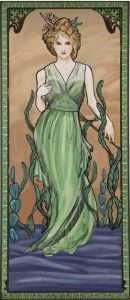
Stylized rendering of costumes
Characters
The Mermaids
The traveling group of mermaids includes 3-5 unique characters who’s backstories and personalities can be tailored to the cast who play them. Since mermaids are half fish, they will be relegated to stay within the cart which functions as their “water tank.” Their costumes reflect 1900s fashion with an oceanic twist. The tail is primarily rendered through a motion tracking camera and animated screen illusion (more information below), but the costumes also incorporate physical fins made of a lightweight and breathable material. These fins are subtle and practical so as not to obstruct the actor’s movement within the cart. The primary role of the mermaids is to theatrically assemble the ingredients, create drinks, and engage the guests while maintaining their mermaid persona.
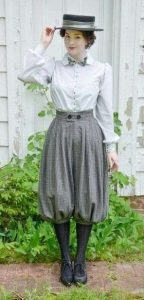
Clayton, Angela. “CYCLING COSTUME 1890’S, PHOTOS.”
The Humans
As traveling companions to the mermaids, the human characters support the troupe in several ways. They take costumer orders, manage the que and assist with the production of drinks. Since the mermaids do not have legs, any task which requires a character to leave the cart is performed by humans.
Creating a Mermaid Tail
Philosophy
The tail illusion is utilized as a subtle accent rather than a centerpiece of the experience. It serves to further convince the guest they are being served by a true mermaid. In that sense it should be thought of as costuming; it aims to enhance the actors performance rather than to distract from it.
Technology
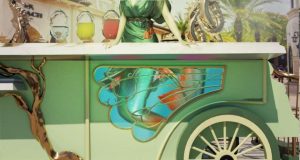
The tail illusion is rendered with a motion sensing camera and a screen mounted behind glass within the cart. Through the use of skeletal mapping, the tail can be synchronized with her body giving her freedom to improvise an expressive performance.
AJ Freyseinson, creative director and CEO of Rabcup, a video production studio kindly gave a consultation on this project. He estimated the cost of the illusion including hardware and content development to come to about $12,000. The illusion would make use of a simple tv screen masked within the cart, as well as an Intel Realsense camera which can scan between 2.5-8 meters. Skeletal mapping can be used to read and respond to the actors movements in real time giving her the ability to freely move about the cart while the illusion of the tail animates in response.
Sight Lines
The walls of the cart are high enough to obscure the sight lines of most guests, however fog and lighting can be used to disguise her land legs from the guests who are tall enough to peer behind the counter.
The Offering
Souvenir Cups
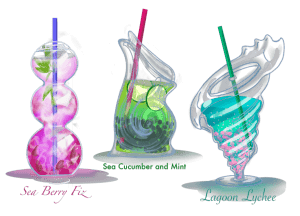
Similarly to Trader Sam’s, several menu items can be upgraded for a premium. These take-home cups come in fantastical ocean themed shapes and can only be purchased with the drink they are associated with. To collect them all, the guests will have to explore several drinks on the menu.
 Exhibiting the Ingredients
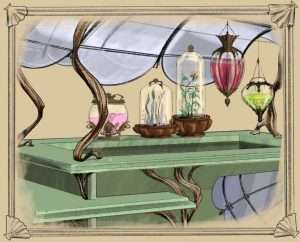
Each drink will be a colorful combination of ocean flavors such as “sea cucumber,” “Blue Algae,” or “jellyfish eggs.” The mermaids gather their supplies from the myriad of fancy decanters and tanks and create each drink right in front of the guests. Bubble tea toppings include jellies, tapioca (white and black), Star jellies, pudding, cheese foam and popping boba. Watching your mer-host dispense, scoop or squirt the ingredients constitutes a lively and entertaining performance.
Food Safety
Some ingredients such as milk powders and syrups have no temperature requirement and can be displayed in open air without risk of spoiling. For the ingredients which require refrigeration or heat (i.e. teas and boba), they can be stored safely within the cart while a fabricated display is positioned in the guest view. A similar tactic is utilized in Disney’s Galaxy’s Edge where the blue and green milk appears to be suspended in glass orbs above the guests. The real product is safely stored out of sight within a refrigerated dispenser.
Budget
For more information regarding start up and monthly costs, see the following link. La Mer Financial Layout
References
“Arts and Crafts Movement.” Encyclopædia Britannica, 15 Apr. 2023, www.britannica.com/art/Arts-and-Crafts-movement.
Clayton, Angela. “CYCLING COSTUME 1890’S, PHOTOS.” Doxiequeen1.Wordpress.Com, WordPress, 15 July 2016, https://doxiequeen1.wordpress.com/tag/cycling-costume/. Accessed 29 May 2023.


Join us
Comments