
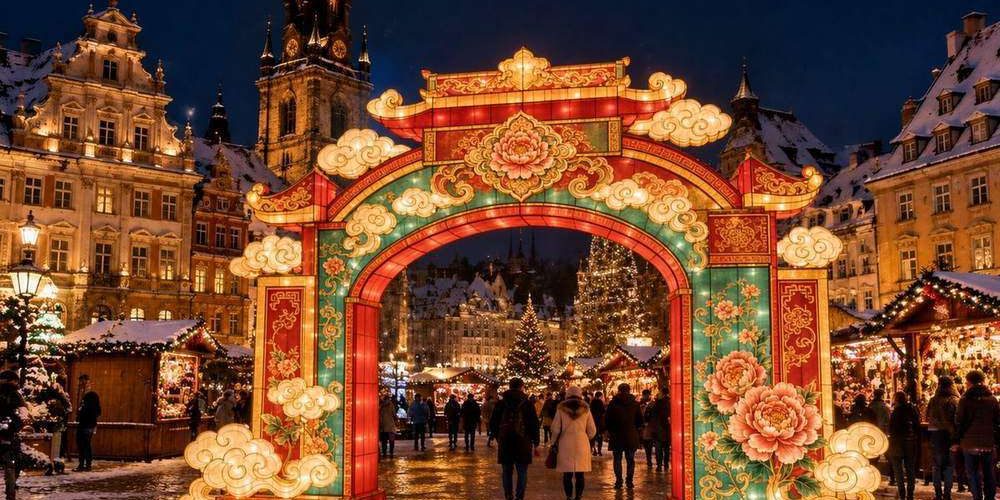
Every attraction operator knows the shape of the winter curve. Attendance falls, staffing stays, and the fixed costs of a site that was built for summer do not move at all. The usual answers are discounting, limited opening days, or simply absorbing the loss and calling it seasonal.
There is a third option that most venues underweight: build a night-time product that only works in winter. A lantern trail is not a summer attraction in a coat. It is a distinct proposition that happens to be better in the cold, the dark and the early nightfall.
Here is the case for it, and the parts that decide whether it works.
Winter is the only season when darkness is free
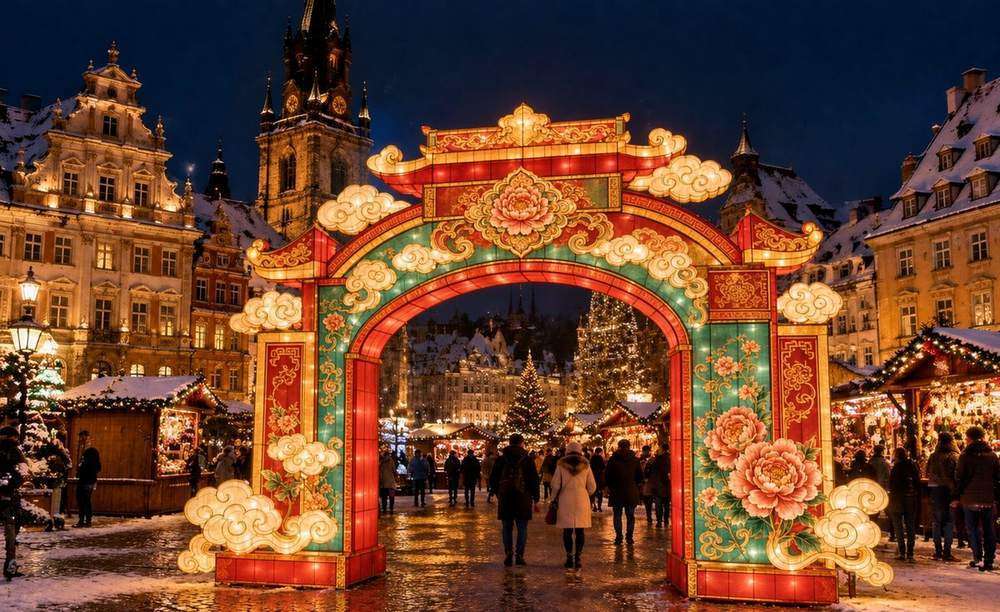
The economics of any illuminated attraction depend on how many hours of darkness you can sell. In July, a venue in the northern hemisphere gets perhaps three usable night hours, and it has to compete with every other summer activity in the market. In December, the same site has five to six hours of darkness during normal opening times, and almost nothing else is running outdoors.
That inversion is the whole argument. A lantern trail installed in a summer park is fighting the sun. The same trail installed in winter is using hours the site already had but could not monetise.
The audience changes, and that changes the design
Winter visitors are not the same as summer visitors. They arrive in family groups, they arrive earlier in the evening, and they have a much lower tolerance for anything that requires queuing outdoors in the cold.
That has direct design consequences. Routes need to be shorter than a summer trail, with more sheltered stopping points and a clear direction of travel so nobody has to double back into the wind. Density matters more than scale: a compact route of twelve pieces reads as busier and warmer than a sparse route of twenty spread over a kilometre.
Where a site has indoor or covered space, the transition points between warm and cold are the most valuable real estate in the whole layout. Visitors will stop there, and a stop is where dwell time and secondary spend happen.
Three shapes, three different businesses
Winter light programmes tend to fall into three structures, and they are not interchangeable.
**The trail.** A ticketed route through a defined path, usually 45 to 90 minutes. This is the highest-revenue model per visitor and the one that needs the most operational discipline: timed entry, a clear route, and enough spacing that the trail never becomes a queue in the cold.
**The destination.** A single large piece at the centre of a site, free to visit or included in general admission. Lower revenue per head, but it works as a reason to open at all, and it converts existing daytime traffic into an evening visit.
**The plaza.** A public or semi-public space that operates as a gathering point rather than a route. This is the model that works best where a venue has a town-centre location or a partnership with a local authority, because the audience does not have to be convinced to buy a ticket.
Most venues that succeed with winter lighting run a destination piece and a trail together: the landmark gives people a reason to come, the trail gives them a reason to stay.
Cold is a constraint, not a blocker
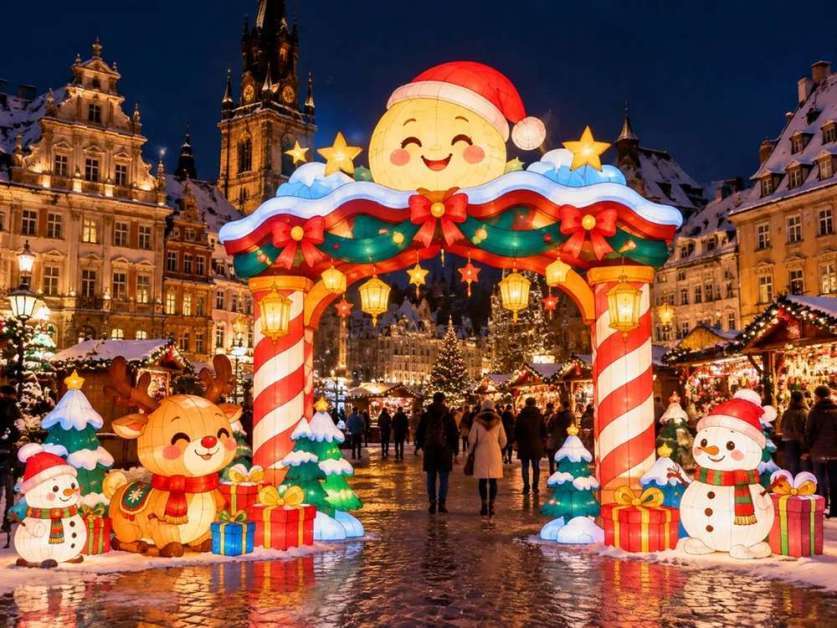
The instinct is that cold weather limits what can be installed. In practice the constraints are narrower than operators expect, and they are mostly about operations rather than fabrication.
Ground conditions matter more than temperature. Frozen ground changes how bases can be set, and a site that cannot be anchored in summer almost certainly cannot be anchored in winter. Surfaces that hold water become the real risk, because ice underfoot is a liability question rather than a design question.
The other operational item is the staff working the site after dark. Anyone running a winter trail needs to plan for rotation, warm rooms and the assumption that a shift will be shorter than in summer.
What does not change is the display itself. Illuminated structures are built for outdoor exposure year-round; the winter question is site management, not whether a piece can survive a frost.
The part that decides the result: the calendar, not the artwork
The most common failure in winter lighting is not a bad design. It is a programme that starts too late to be finished properly.
A custom display is not a stock order. Concept, drawings and fabrication alone run several months, and sea freight adds weeks more before anything reaches the site. A venue that decides in September to open a December trail is already compressing the part of the project where quality gets decided.
The practical answer is to treat winter lighting as a year-round planning item rather than a seasonal purchase: concept in spring, fabrication over summer, installation in autumn, run through the winter. That sequence costs nothing extra and removes the single biggest source of compromised results.
Why this is worth doing now
Winter lighting is not a novelty category any more. Visitors have seen enough of it that the standard has risen, and a programme that would have impressed an audience five years ago now reads as thin.
That cuts both ways. It means the barrier to a mediocre result is higher, but it also means the venues that do it properly are taking a share of a market that used to be empty for everyone. For a site with an existing infrastructure, existing staff and six hours of unused darkness every evening, that is the most available growth in the calendar.
About the author
Zheng Hongfeng works on international outreach and partnerships at Zigong Huilongtang Culture & Art Co., Ltd., a festival lantern manufacturer based in Zigong, Sichuan — the city that has produced large-scale illuminated displays for centuries. The company builds custom lantern installations for city programmes, zoos, botanical gardens and theme parks.



Join us
Comments