
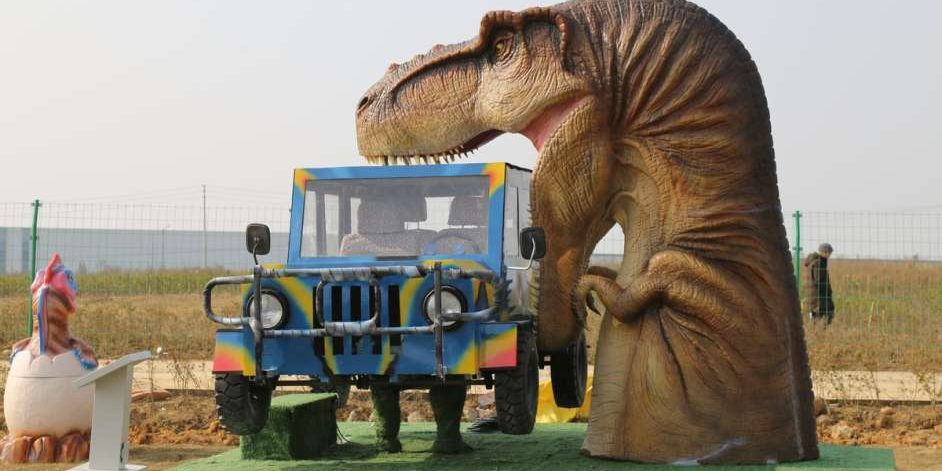
Walk through any dinosaur park built before 2015 and you will find the same layout: a trail, a fence, and a row of animals behind it. The animals are good. The problem is that the visitor’s only job is to look.
Look at what actually gets posted online from those parks. It is almost never the animal. It is a child standing in front of one, or a family squinting into a phone camera at arm’s length. The exhibit supplies a backdrop; the visitor supplies the event.
The rides that have been replacing those backdrops do the opposite. They manufacture the event, and they manufacture it in about ninety seconds.
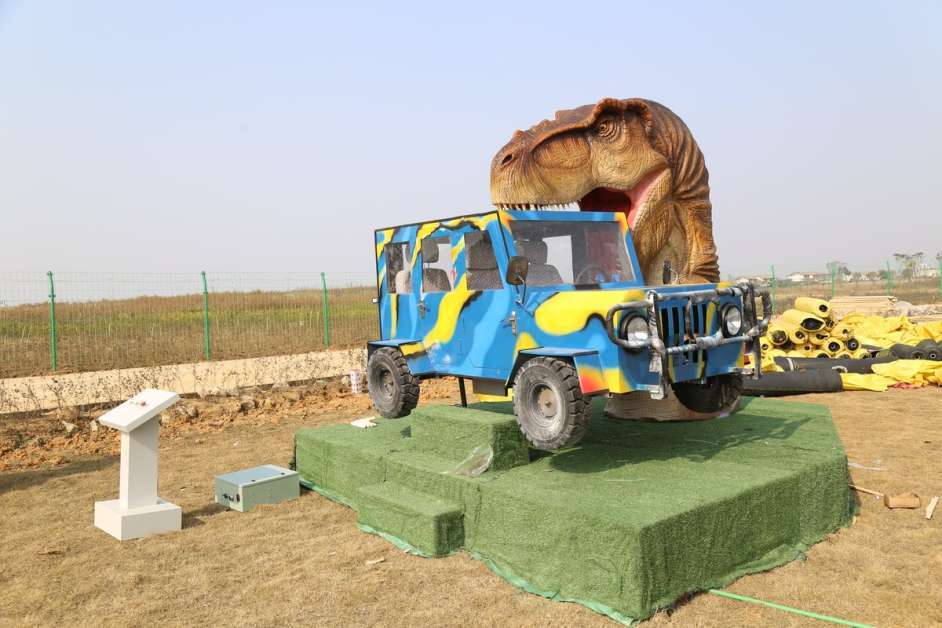
What a bite-car ride actually is
The premise is simple enough to describe in one sentence: a visitor sits inside a jeep cockpit, a large theropod head comes down over the roof, and the jaws close a metre above them.
The photograph is the product. Everything else — the animal’s skin, the vehicle’s bodywork, the control program — exists to make that one frame believable and repeatable, four passengers at a time, several hundred times a day.
That reframing changes the engineering brief completely. The head does not need to be a complete animal with a walking gait. The jeep does not need an engine. What it needs is a jaw that closes at the right height, on cue, on the first take, with a family inside who feels something without being in any danger.
The jaw timing is the experience
Most of the design work goes into a mechanism that spends eighty percent of its cycle doing nothing.
A cycle runs eight to twelve seconds. If the head closes the instant someone sits down, the photograph catches a closed mouth and the passengers never had time to feel threatened. What works is a sequence with pauses built in: trigger on entry, hold while the passengers settle, a slow close that stops short of contact, a second hold long enough for a camera, then the retreat.
The number of cycles is a commercial decision as much as an engineering one. A ride that runs continuously reads as a machine; a ride that runs on a trigger reads as an animal that noticed you. The second version photographs better and queues better, because the group behind can see the jaw move and knows what is coming.
Why the vehicle is built, not bought
The instinct for anyone specifying a ride of this kind is to buy a used jeep body and mount it on a frame. It looks cheaper on the quote and it is the wrong decision for a fixed installation.
A road vehicle is designed to carry its weight on four wheels and a suspension, with a driver sitting at one specific height. A ride needs the opposite: a body that stays rigid while a head comes down on top of it, mounted on a base that never moves, with four passengers seated so that all four faces are visible to a camera at the same time.
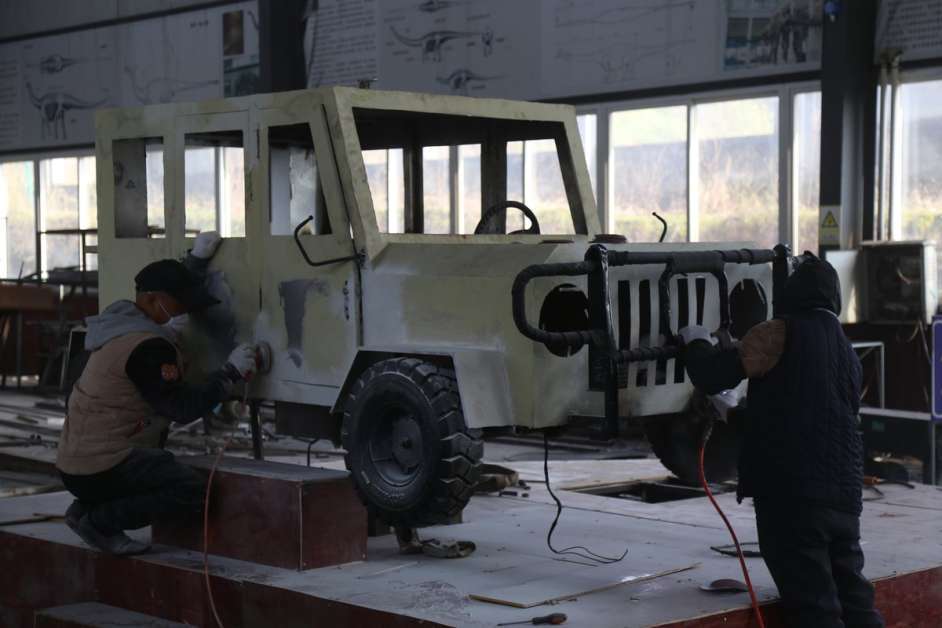
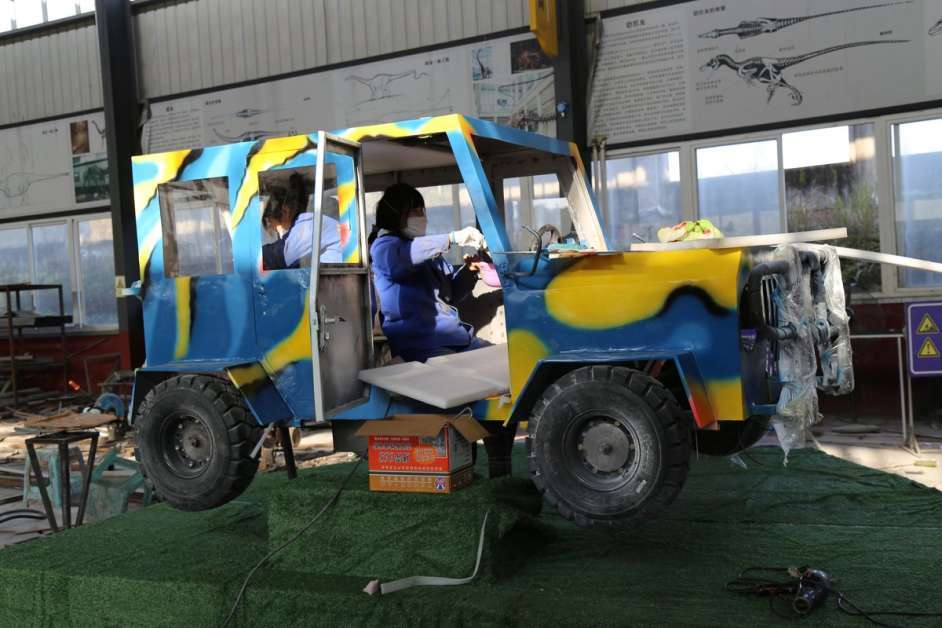
So the vehicle is fabricated rather than adapted. The chassis and body panels are built to the ride’s dimensions, then the cosmetic parts — grille, lights, wheel arches, decals — go on afterwards. The result is a jeep that reads correctly from three metres away and behaves correctly under load, which a converted vehicle never quite does.
Inside, the cockpit is fitted out rather than stripped. The dashboard and steering wheel are real components, not moulded props. That sounds like a trivial detail until you watch a family sit down: the front two reach for the wheel immediately, and the photograph stops looking like people posing in a prop and starts looking like people who found themselves in a vehicle they cannot drive away.
Four seats is the working number. Two is easy to build and hard to monetise, because a two-seat ride photographs as a couple rather than a group, and groups are what fill queues.
The body has to move, or the frame falls flat
The single most common failure in this category is a head that performs above a vehicle that does not.
If the jaw closes over a stationary body, the eye reads two separate machines: an animal doing something, and a prop that happens to be underneath it. The fix is to program the vehicle’s motion into the same cycle — a heave and a slight pitch, timed to the jaw, so the passengers feel the jeep react at the moment the head arrives. The head supplies the threat; the body supplies the consequence.
That timing has to be tuned on site, not in a workshop. The delay between the trigger, the body movement and the jaw close is set against the actual approach path and the actual camera position, and it will be different for every installation.
The commercial case
Operators rarely buy this kind of ride because it is a better exhibit. They buy it because it produces a specific asset: a photograph taken by a visitor, from inside the experience, that goes out to their own network with the park’s branding in frame.
That is the cheapest distribution a park has, and it only works when the photograph is worth posting. A static exhibit can be photographed from outside by anyone who walks past. A bite-car ride can only be photographed from inside, by someone who queued for it.
The throughput maths follows from the cycle time. Ninety seconds of experience plus turnover time sets the queue rate, and four seats per cycle is the multiplier that makes a paid attraction viable rather than a novelty.
What to specify
If you are writing a brief for this kind of build, four items decide whether it works:
- The jaw height above the passengers. Too close and the ride fails a safety review; too far and the photograph loses its tension.
- The cycle, including the pauses. Ask for the sequence in seconds, not the mechanism.
- The vehicle’s construction. Ask whether the chassis is fabricated to the ride or adapted from a road vehicle. The answer tells you how the thing will behave in year three.
- The motion program. Ask whether the body moves with the jaw, and ask to see it running with passengers before you sign off.
If you are weighing a ride against a static build, the earlier piece on how animatronic dinosaurs became the centrepiece of family nights covers the economics of the exhibit around it — dwell time, evening programming and what actually keeps a family on site after dark.
More on how this build is specified, including seating, clearance and cycle timing, is published on the manufacturer’s product page for the interactive T-Rex bite-car ride, which carries the full specification table.



Join us
Comments